Bruise color stages: what red, purple, green, yellow and brown mean
 By Margaret Hale, Reunoa EditorialLast updated
The short answer
A bruise usually goes from red or purple in the first days, to blue-black, then green, yellow and finally brown before fading. The colours come from haemoglobin being broken down into biliverdin (green) and bilirubin (yellow), with iron left as brown hemosiderin. After 60 the whole process often takes two to four weeks.
Key takeaways
- Colour changes reflect your body breaking down trapped blood — they're a sign of normal healing [1].
- Timing varies widely; colour can't reliably tell exactly how old a bruise is, but yellow means it isn't fresh [2].
- The flat purple patches of senile purpura often skip the green-yellow stage and simply fade [3].
- Brown that lingers for months is usually iron (hemosiderin) staining.
- See a doctor for bruises that grow, harden, get more painful or show signs of infection.
On this page
- Why bruises change colour
- The stages, one by one
- Does skin tone change what you see?
- Stage 1–2: red and purple
- Stage 3–4: green and yellow
- Stage 5: brown — and why it sometimes stays
- A special case: senile purpura
- What can change the colour timeline?
- Colours and signs that need a doctor
- Frequently asked questions
A bruise is like a slow-motion colour show. Knowing what each colour means can be reassuring — and can help you spot the rare bruise that isn't healing normally.
Why bruises change colour
When small blood vessels break, red blood cells leak into the tissue. Your body then sends cleaning cells to break them down in steps [1]:
- Haemoglobin (red, carrying oxygen) → appears red, then purple-blue as it loses oxygen
- Biliverdin (green) → the first breakdown product
- Bilirubin (yellow) → the next step
- Hemosiderin (golden-brown) → stored iron that's cleared last
The stages, one by one
| Stage | Colour | Typical timing after 60 | What's happening |
|---|---|---|---|
| 1 | Red / pink-red | First hours to day 2 | Fresh, oxygen-rich blood under the skin; may be tender and swollen |
| 2 | Purple, blue, blue-black | Days 1–5 | Blood loses oxygen and darkens |
| 3 | Green | Days 5–10 | Haemoglobin is broken down to biliverdin |
| 4 | Yellow | Days 7–14+ | Biliverdin becomes bilirubin; the bruise is clearing |
| 5 | Light brown | Weeks 2–4 | Iron (hemosiderin) is being removed |
| 6 | Normal skin | 2–4 weeks, sometimes longer | Cleared — or a brown mark remains |
Timings overlap and vary widely. A review of the science of bruise dating found that visual estimation is unreliable; the one consistent finding is that yellow indicates a bruise isn't recent [2]. Older skin, blood thinners and larger bruises all slow the process.
Does skin tone change what you see?
Yes. On darker skin, the early red stage can be hard to see, and a fresh bruise may look dark brown, deep purple or almost black. The later green and yellow stages are often subtler. Feel matters more than colour: a fresh bruise is usually tender and slightly raised, and the tenderness fades as it heals. On very pale, thin, older skin the colours are vivid because there's so little tissue covering the blood [5].
Stage 1–2: red and purple
The first 48 hours are the "active" phase, when the vessels may still be leaking. This is when cold, rest, elevation and gentle pressure help most. See how to get rid of bruises faster.
Stage 3–4: green and yellow
This is good news: your body is clearing the blood. Gentle warmth can boost circulation now. Topical ingredients studied for faster fading include high-strength arnica [6] and vitamin K applied after the bruise has formed [7].
Stage 5: brown — and why it sometimes stays
Brown is the last stage. In thin, sun-aged skin, or when bruises keep forming in the same spot, iron builds up faster than it's cleared, leaving a lasting stain [3]. Read hemosiderin staining.
A special case: senile purpura
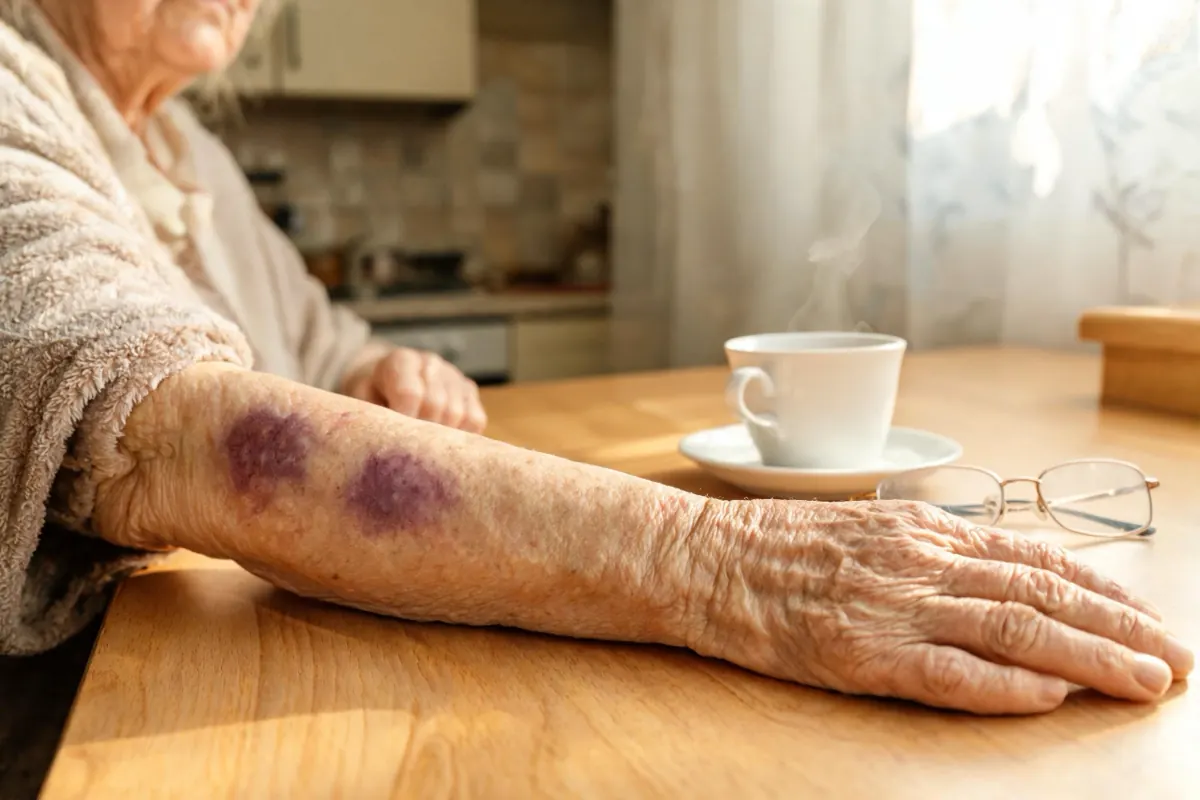
The flat, dark purple patches that appear on older forearms after tiny knocks often don't go through the green and yellow stages. They stay purple, then fade over up to three weeks, sometimes leaving brown [3]. They're harmless but a sign of fragile skin. See our senile purpura guide.
What can change the colour timeline?
| Factor | Effect |
|---|---|
| Age over 60 | Slower clearing; bruises often last 2–4 weeks |
| Blood thinners or daily aspirin | Larger bruises that take longer to move through the stages |
| Bruise depth | Deep bruises may appear late and show up as yellow-green first |
| Location | Bruises on the shins and feet clear slowest because circulation is slower |
| Repeated knocks to the same spot | Overlapping colours and more brown staining |
Because so many things affect the timeline, use colour only as a rough guide to healing, not as a clock.
Colours and signs that need a doctor
Frequently asked questions
What color is a bruise when it's healing?
Green and yellow mean a bruise is healing. Green appears as haemoglobin breaks down into biliverdin, and yellow as it becomes bilirubin. Light brown is the last stage before the skin returns to normal.
What does a dark purple bruise mean?
Dark purple or blue-black is a fresh bruise, usually a few hours to a few days old, where trapped blood has lost its oxygen. On older forearms, flat dark-purple patches that don't change colour much are often senile purpura.
Why is my bruise green?
Green means your body has started breaking down the haemoglobin into biliverdin. It typically appears around five to ten days after the injury and is a normal sign of healing.
Why does a bruise turn brown?
Brown comes from hemosiderin, the iron left after red blood cells are broken down. It's the final stage. If brown marks stay for months, it's called hemosiderin staining.
Can you tell how old a bruise is by its color?
Only roughly. Research shows visual dating is unreliable because healing speed varies with age, skin, medicines and bruise size. Yellow does suggest a bruise isn't brand new.
Sources
- Bruise — MedlinePlus Medical Encyclopedia.
- Langlois NE The science behind the quest to determine the age of bruises — a review of the English language literature. Forensic Science, Medicine and Pathology, 2007. PubMed 25869263
- Senile purpura — DermNet (New Zealand).
- Bleeding into the skin — MedlinePlus Medical Encyclopedia (U.S. National Library of Medicine).
- Aging changes in skin — MedlinePlus Medical Encyclopedia.
- Leu S, et al. Accelerated resolution of laser-induced bruising with topical 20% arnica: a rater-blinded randomized controlled trial. British Journal of Dermatology, 2010. PubMed 20412090
- Shah NS, et al. The effects of topical vitamin K on bruising after laser treatment. Journal of the American Academy of Dermatology, 2002. PubMed 12140470
General information, not medical advice. Written by the Reunoa editorial team; Reunoa makes Bruise Defense & Repair Serum. See our editorial policy for how we pick sources and keep product mentions fair.