Hemosiderin staining: why brown marks stay after bruises — and what helps them fade
 By Margaret Hale, Reunoa EditorialLast updated
The short answer
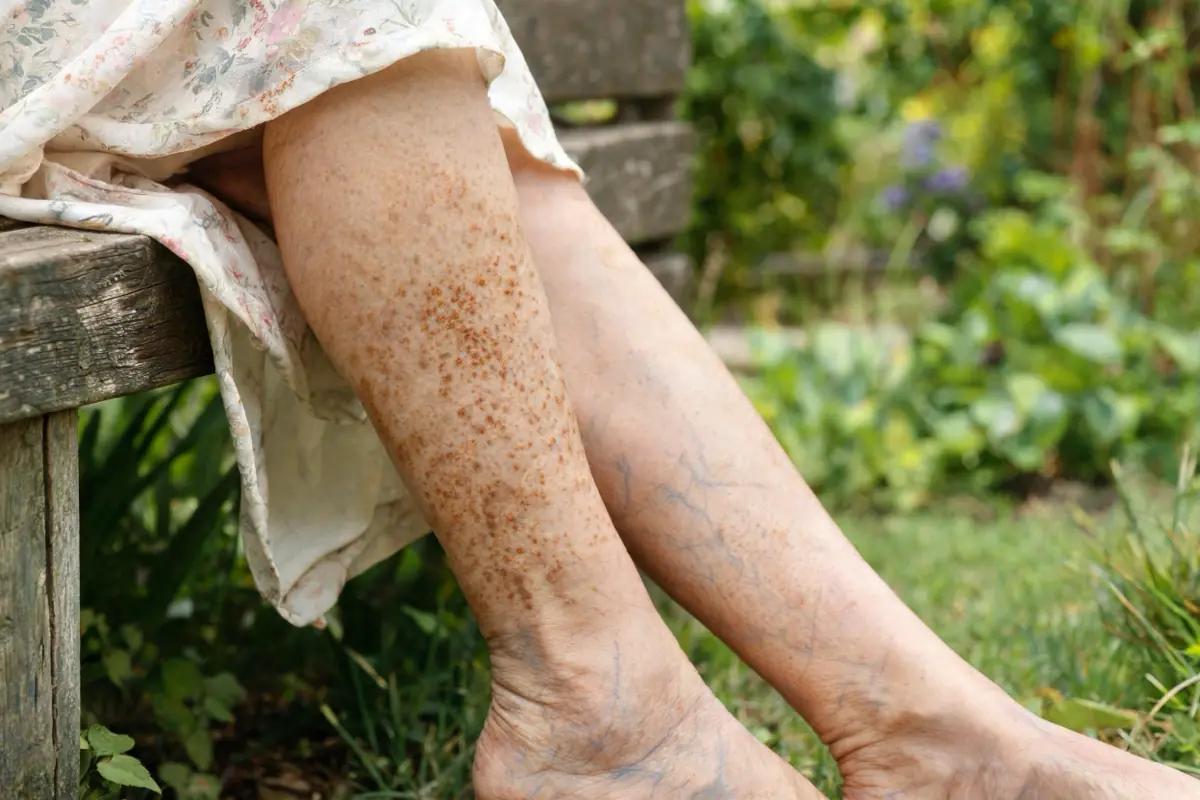
Hemosiderin staining is a brown, rust or copper-colored mark caused by iron left in the skin after red blood cells leak out of small vessels and break down. It often follows repeated bruising on thin forearms, or appears on the lower legs with vein problems. It can fade slowly over months, but on the legs it may be permanent unless the cause is treated.
Key takeaways
- Hemosiderin is an iron-storage protein left behind when your body breaks down leaked red blood cells [1].
- On the forearms, brown marks commonly follow repeated purpura patches; on the lower legs they often signal chronic venous insufficiency [2].
- In leg vein disease, iron deposits are found in the more severe stages — skin hardening and ulcers — so new brown staining on the legs deserves a vein check [5].
- Stains fade slowly, if at all. Protecting the skin, treating leg swelling and avoiding new bruises are the most important steps.
- Laser treatment can lighten some persistent stains, with partial results [6].
On this page
You've waited for the bruise to fade. The purple went away weeks ago — but a brown, rusty patch is still there. Or you've noticed coppery freckling spreading on your shins that was never a bruise at all.
Both are very often hemosiderin staining. In our anonymous survey of U.S. adults over 55, almost 1 in 6 (16%) said "some bruises never fully fade — they leave brownish stains" [11]. Here is what that brown actually is, why it stays, and what can help.
What is hemosiderin?
When blood leaks out of a vessel into the skin, your body sends cleaning cells to break the red blood cells down. Haemoglobin, the red pigment, is converted step by step — that is why a bruise turns blue, then green, then yellow [7]. The iron from the haemoglobin is stored in a protein called hemosiderin, which is golden-brown.
Normally the body removes this iron over time. But when bleeding into the same skin happens again and again — or the skin's circulation is poor — hemosiderin builds up faster than it is cleared, leaving a persistent brown mark. DermNet notes that persistent brown pigmentation after senile purpura results from hemosiderin deposition [1].
The two common types
| After bruising (forearms, hands) | With vein problems (lower legs) | |
|---|---|---|
| Looks like | Brown or rust patch where purple patches used to be | Rust or copper freckles and patches on shins, ankles, inner calves |
| Cause | Repeated leaks from fragile, sun-aged vessels (senile purpura) | Blood pooling in leg veins forces red cells out into the skin |
| Comes with | Thin, translucent skin, purple patches | Swelling, heaviness, aching, itchy skin, sometimes varicose veins |
| Outlook | Often fades slowly over months if new bruising stops | Usually persists; may darken if veins aren't treated |
Brown marks after bruises
This is the type many people with senile purpura notice on their forearms. Each purple patch leaves a little iron behind, and on thin, slow-healing skin it accumulates. Read our senile purpura guide for the full picture.
Brown staining on the legs
On the lower legs, hemosiderin staining is often a sign of chronic venous insufficiency — the valves in the leg veins don't close properly, blood pools, and pressure pushes red cells into the skin. MedlinePlus describes how the skin of the ankles and lower legs may first look thin, then slowly turn brown, and over time can thicken and harden or develop sores [2].
A study of skin samples from people with chronic venous disease found hemosiderin always present in hardened skin (lipodermatosclerosis) and in ulcers, but not in the milder stages [5]. In other words: brown staining on the legs is worth showing to a doctor, because treating the vein problem can prevent more serious skin changes.
Is hemosiderin staining dangerous?
The brown pigment itself is harmless. What matters is the cause:
- On the forearms, with a history of purple patches, it is usually just a cosmetic after-effect of fragile skin.
- On the legs, it can be an early sign of vein disease that needs treatment to protect the skin [3].
How long does hemosiderin staining last?
There's no fixed timeline. Light staining after a single bruise may fade over a few months. Stains built up from many bruises, or from long-standing vein disease, can last for years or be permanent. The more new bleeding into the same area you prevent, the better the chance it lightens.
Treatment: what can help
Stop new bleeding into the skin
This is the most important step. For forearms: protect against knocks, moisturise to keep skin supple — twice-daily moisturising cut skin tears by almost half in one trial [10] — and use products designed for fragile skin. If you take a blood thinner, keep taking it; see bruising on blood thinners.
Treat the veins (legs)
For leg staining, managing the vein problem comes first. MedlinePlus lists compression stockings, raising the legs and treating the underlying vein condition [2]. DermNet also recommends leg elevation, compression and moisturising for venous skin changes [4]. A vein specialist can discuss procedures if needed.
Protect from the sun
Sun can darken any pigmented mark and further thins the skin on forearms. A broad-spectrum sunscreen of SPF 30 or higher is the standard recommendation [9].
Laser
Some lasers target iron pigment. In a small study, 45% of long-standing hemosiderin stains after vein treatment lightened with a pulsed dye laser, and 27% lightened significantly [6]. Results are partial and treatment is usually not covered by insurance.
Topical products
No cream has been proven to remove hemosiderin. Ingredients that support the skin barrier and help fresh bruises clear — such as arnica, vitamin K and ceramides — may help by reducing new bleeding into the skin, which is what feeds the staining. Be cautious with strong bleaching creams on thin skin.
Frequently asked questions
What does hemosiderin staining look like?
It looks like brown, rust, copper or bronze-coloured patches or freckling on the skin. After bruising it appears where purple patches used to be, usually on forearms. With vein problems it appears on the shins, ankles and inner calves, often with swelling.
Does hemosiderin staining ever go away?
Light staining can fade over months if no new bleeding happens in the area. Heavy or long-standing staining, especially on the legs from vein disease, is often permanent. Treating the cause and preventing new bruises gives the best chance of lightening.
Is hemosiderin staining a sign of poor circulation?
On the lower legs, often yes: it commonly signals chronic venous insufficiency, where blood pools in the leg veins. On the forearms it is more often due to repeated bruising on fragile skin. Brown staining on the legs should be checked by a doctor.
What is the best treatment for hemosiderin staining?
The best treatment is stopping the cause — preventing new bruises on the arms and treating vein problems in the legs with compression and elevation. Some lasers can lighten persistent stains partially. No cream has been proven to remove the iron pigment itself.
Why are my old bruises leaving brown marks?
When bruises happen repeatedly in the same thin skin, iron from broken-down red blood cells (hemosiderin) builds up faster than your body can clear it. Older skin also clears this pigment more slowly, so the brown can remain long after the purple has faded.
Is hemosiderin staining the same as age spots?
No. Age spots (lentigines) are caused by sun-induced melanin and appear as flat, evenly coloured brown spots on sun-exposed skin. Hemosiderin staining is iron from leaked blood, usually rust-coloured, and follows bruising or leg vein problems.
Sources
- Senile purpura — DermNet (New Zealand).
- Stasis dermatitis and ulcers — MedlinePlus Medical Encyclopedia.
- Venous insufficiency — MedlinePlus Medical Encyclopedia.
- Venous eczema — DermNet (New Zealand).
- Caggiati A, et al. Skin iron deposition characterises lipodermatosclerosis and leg ulcer. European Journal of Vascular and Endovascular Surgery, 2010. PubMed 20880725
- Goldman MP Postsclerotherapy hyperpigmentation. Treatment with a flashlamp-excited pulsed dye laser. Journal of Dermatologic Surgery and Oncology, 1992. PubMed 1607465
- Langlois NE The science behind the quest to determine the age of bruises — a review of the English language literature. Forensic Science, Medicine and Pathology, 2007. PubMed 25869263
- Aging changes in skin — MedlinePlus Medical Encyclopedia.
- How to select a sunscreen — American Academy of Dermatology.
- Carville K, et al. The effectiveness of a twice-daily skin-moisturising regimen for reducing the incidence of skin tears. International Wound Journal, 2014. PubMed 25040325
- Fragile Skin Report 2027 — aggregated, anonymous answers from the Reunoa skin quiz — Reunoa Editorial (learn.reunoa.com).
General information, not medical advice. Written by the Reunoa editorial team; Reunoa makes Bruise Defense & Repair Serum. See our editorial policy for how we pick sources and keep product mentions fair.