How long does a bruise last after 60?
 By Margaret Hale, Reunoa EditorialLast updated
The short answer
In younger adults, most bruises fade within about two weeks. After 60, two to four weeks is common, and bruises on blood thinners or on very thin forearm skin can last longer. Some leave a brown stain for months. A bruise that grows, gets more painful, or hasn't clearly faded after a month should be checked by a doctor.
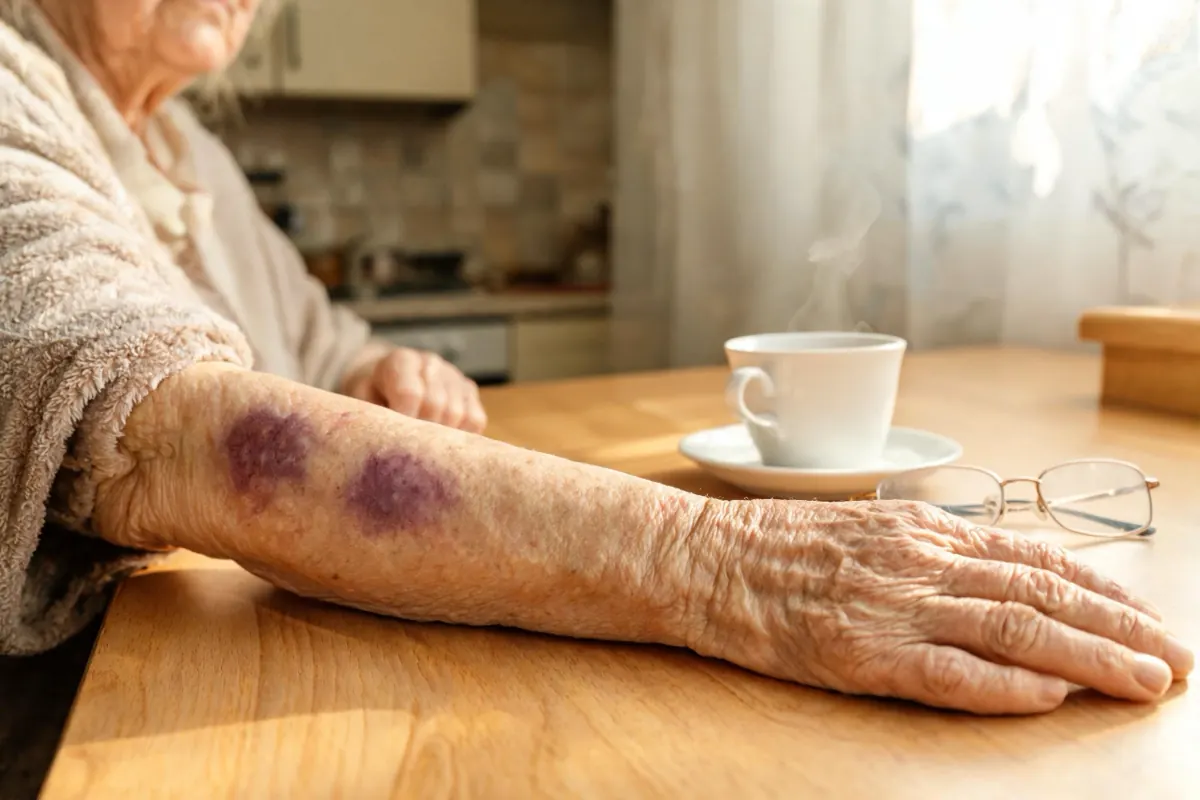
If it feels like your bruises hang around much longer than they used to, you're right — and you're not alone. In our anonymous quiz of U.S. adults over 55, 45% said a typical bruise lasts two to three weeks, 17% said a month or more, and 16% said some never fully fade [6].
A realistic timeline after 60
| Time | What you'll usually see |
|---|---|
| Day 0–2 | Red, purple or dark blue; may be tender or slightly swollen |
| Days 2–7 | Purple to blue-black, spreading slightly as blood settles |
| Days 5–14 | Edges turn green, then yellow as the body breaks the blood down |
| Weeks 2–4 | Yellow-brown, fading to normal skin colour |
| Beyond 4 weeks | A brown mark may remain — this is iron (hemosiderin), not active bleeding |
MedlinePlus describes the typical sequence as pinkish-red, then bluish, then greenish-yellow before returning to normal skin colour [1]. Exact timing varies a lot from person to person, and even experts can't reliably date a bruise by its colour — though yellow suggests a bruise isn't fresh [2]. See bruise color stages.
Why bruises last longer as we age
- Thinner skin, more fragile vessels. Older skin has less collagen and fat padding, so more blood leaks from the same bump [4].
- Slower clean-up. Circulation and the cells that clear leaked blood work more slowly with age.
- Medicines. On blood thinners or daily aspirin, more blood escapes before the vessel seals, so bruises are larger and take longer to clear [5].
- Senile purpura. The flat, dark-purple patches on forearms often stay purple and take up to three weeks to resolve, sometimes leaving brown staining [3].
Can you make a bruise go away faster?
Somewhat. Cold in the first 48 hours, rest and elevation, then gentle warmth, plus topical ingredients like high-strength arnica and vitamin K, can shorten healing. Our step-by-step guide: how to get rid of bruises faster.
Frequently asked questions
How long should a bruise last in an elderly person?
Two to four weeks is common after 60. Bruises on blood thinners, or the flat purple patches of senile purpura, can take a bit longer and may leave a brown stain. A bruise that hasn't clearly faded after a month should be checked.
Why won't my bruise go away after a month?
Often the purple has gone but a brown iron stain (hemosiderin) remains, which can last months. If the area is still purple, swollen, hard or painful after a month, see a doctor to rule out a collected blood pocket (hematoma) or another cause.
Do bruises last longer on blood thinners?
Usually yes. More blood leaks before the vessel seals, so the bruise is larger and takes longer to clear. Don't stop your blood thinner — tell your doctor if bruises are frequent or large.
Is a bruise that turns yellow healing?
Yes. Yellow means your body has broken down the blood pigment into bilirubin and is clearing it. It's a sign the bruise is in its later stages.
Sources
- Bruise — MedlinePlus Medical Encyclopedia.
- Langlois NE The science behind the quest to determine the age of bruises — a review of the English language literature. Forensic Science, Medicine and Pathology, 2007. PubMed 25869263
- Senile purpura — DermNet (New Zealand).
- Aging changes in skin — MedlinePlus Medical Encyclopedia.
- Blood Thinners — MedlinePlus (U.S. National Library of Medicine).
- Fragile Skin Report 2027 — aggregated, anonymous answers from the Reunoa skin quiz — Reunoa Editorial (learn.reunoa.com).
General information, not medical advice. Written by the Reunoa editorial team; Reunoa makes Bruise Defense & Repair Serum. See our editorial policy for how we pick sources and keep product mentions fair.