Skin tears: what they are, how to care for them and how to prevent the next one
 By Margaret Hale, Reunoa EditorialLast updated
The short answer
A skin tear is a wound where fragile, aging skin splits or a flap of skin peels back after a minor knock, friction or tape removal. Most heal in about four weeks with gentle cleaning, putting the flap back in place and a non-stick silicone dressing. Twice-daily moisturizing roughly halved new skin tears in a nursing-home trial.
Key takeaways
- Skin tears are common in thin, older skin — about 1 in 5 long-term care residents had one in a 2020 study [3].
- Experts sort them into three types: no skin lost, partial flap lost, whole flap lost [1].
- First aid: stop the bleeding, rinse gently, ease the flap back into place, cover with a non-stick dressing [2].
- Avoid sticky plasters and tape directly on fragile skin — removing them can cause the next tear [1].
- Twice-daily moisturizing of arms and legs cut skin tears by almost half in a randomized trial [4].
On this page
You reach for a cupboard door, brush your forearm against it — and suddenly there is a flap of skin hanging loose and a lot more blood than you expected. That is a skin tear. It is one of the most common injuries in thin, older skin, and it is easy to make worse with the wrong plaster.
This guide explains what a skin tear is, how to care for one at home, when it needs a nurse or doctor, and — most importantly — how to stop the next one.
What is a skin tear?
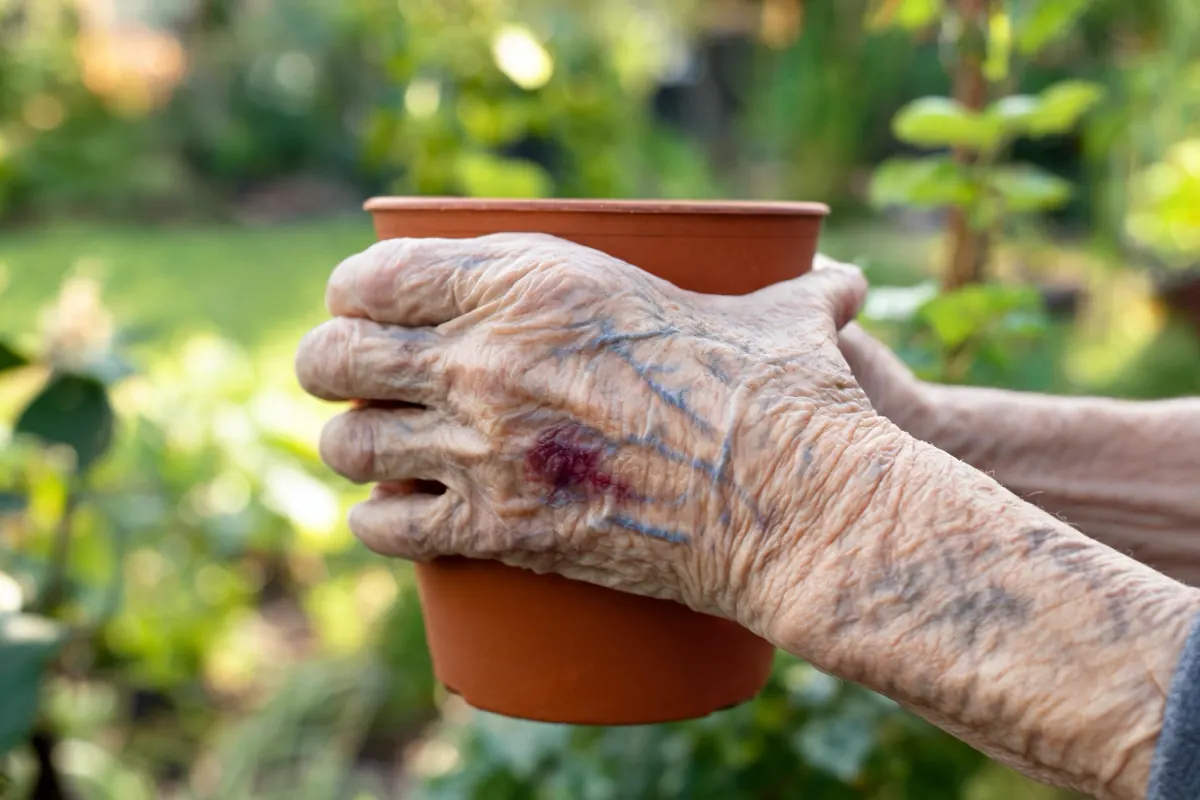
A skin tear is a wound caused by shear, friction or a blunt knock that separates the layers of the skin [8]. In younger skin the same bump would leave a red mark. In skin that has become thin, dry and less elastic with age [9], the top layer can split or peel away like wet tissue paper.
Typical causes:
- bumping an arm or shin against furniture, a wheelchair or a car door
- being lifted or turned by the arms
- pulling off a plaster, tape or a monitoring electrode
- a pet's claw, a ring or a watch strap catching the skin
- falls
Most skin tears happen on the forearms, the backs of the hands and the shins — the same places where bruises and purple patches of senile purpura appear.
How common are skin tears?
Very common, and often overlooked. In a 2020 prospective study of 380 long-term care residents aged 65 and over, 20.8% had a skin tear at the start, and 18.9% developed a new one within four weeks [3]. They are also common at home, but people living alone rarely report them.
Who is most at risk?
A systematic review of risk factors highlights the same pattern again and again [7]:
- advanced age and a history of earlier skin tears
- dry, thin or sun-damaged skin and existing bruising or purpura
- needing help with moving, washing or dressing
- poor balance, falls and limited mobility
- long-term steroid use and blood thinners (bleeding is heavier)
- poor nutrition and dehydration
- confusion or dementia
If someone has had one skin tear, assume they will have another unless something changes.
The three types of skin tear
The International Skin Tear Advisory Panel (ISTAP) uses a simple three-type system that nurses worldwide work with [1] [2]:
| Type | What you see | What it means |
|---|---|---|
| Type 1 — no skin loss | A straight cut or a flap that can be laid back to cover the wound completely | Best outlook; the flap often reattaches |
| Type 2 — partial flap loss | A flap that covers only part of the wound | Part of the wound has to heal from below |
| Type 3 — total flap loss | The whole flap is gone; the wound bed is exposed | Slowest to heal; needs more careful dressing |
Knowing the type helps you describe the wound on the phone to a nurse or GP. More detail: skin tear classification.
First aid for a skin tear
The full step-by-step is in our guide on how to treat a skin tear. In short [2] [10]:
- Stop the bleeding with gentle, steady pressure using a clean cloth. Raise the arm or leg. People on blood thinners may need to press for longer.
- Rinse gently with clean lukewarm water or saline. Don't scrub.
- Ease the flap back over the wound if it is still attached, using a damp cotton bud or gloved finger. Don't stretch it.
- Cover with a non-stick dressing — silicone dressings are preferred because they peel off without pulling skin [1].
- Draw an arrow on the dressing showing the direction the flap lies, so it is lifted the right way next time.
- Hold it in place with a tubular bandage or soft wrap rather than tape on the skin.
Which dressing works best?
Non-adherent, silicone-based dressings are the usual first choice for skin tears [1]. Two recent randomized studies support them: silicone dressings led to faster complete closure than non-silicone dressings [6] (the study was industry-funded), and in a 2024 hospital trial 86% of skin tears were fully healed at three weeks with an adhesive silicone foam, compared with 59% with a meshed silicone layer [5]. Details and what to buy: skin tear dressings.
How long does a skin tear take to heal?
A clean skin tear with the flap in place often heals in about two to four weeks; one that isn't healed after four weeks deserves a professional look. Aging skin heals more slowly in general [11], and Type 3 tears, infection, diabetes, poor circulation and steroid use can stretch that further. See how long a skin tear takes to heal.
How to prevent skin tears
Prevention is where families can make the biggest difference. Our full checklist: how to prevent skin tears in the elderly.
- Moisturize arms and legs twice a day. In a cluster-randomized trial in 14 Australian aged-care facilities, a twice-daily, perfume-free moisturizer on the limbs cut skin tear rates from 10.57 to 5.76 per 1,000 bed days — almost half [4].
- Cover up. Long sleeves, soft trousers, knee-high socks or padded limb protectors ("geri sleeves") take the knock instead of the skin. See best geri sleeves.
- Pad the home. Corners of beds, wheelchair arms and footplates are classic culprits.
- Move people gently. Never pull by the arm; use a slide sheet or lift under the shoulder blades.
- Skip the tape. Use silicone tape or tubular bandages; remove dressings slowly, low and slow along the skin.
- Keep nails short — the person's own and the caregiver's — and take off rings with sharp edges.
- Eat and drink enough. Protein and fluids support skin repair.
Skin tears and bruising: the same root cause
Skin tears, easy bruising and purple patches all come from the same change: thinner skin with less collagen and support around small blood vessels. Medical writers group these under the term dermatoporosis. Anything that keeps skin hydrated, supple and protected helps with all three. Our thin skin guide explains the underlying changes and what has evidence behind it.
A daily serum or cream with barrier ingredients such as ceramides belongs to that routine — on intact skin only, never on an open tear.
Frequently asked questions
What is a skin tear?
A skin tear is a wound where thin, fragile skin splits or a flap of skin peels back after a minor bump, friction or tape removal. They mostly happen on the forearms, hands and shins of older adults.
Should I cut off the skin flap?
No. If the flap is still attached, ease it gently back over the wound. It acts as a natural dressing and can reattach. Only a nurse or doctor should trim skin.
Can I use a regular Band-Aid on a skin tear?
It is better not to. Sticky plasters can tear the surrounding skin when removed. Use a non-stick silicone dressing held in place with a tubular bandage or soft wrap.
Do skin tears need stitches?
Usually not. Thin skin rarely holds stitches well. Most skin tears are treated with careful cleaning, repositioning the flap and a non-stick dressing. Deep, large or heavily bleeding wounds should be seen by a doctor.
How can I stop getting skin tears?
Moisturize your arms and legs twice a day, wear long sleeves or protectors, pad sharp corners at home and avoid tape on your skin. Moisturizing alone cut skin tears by almost half in a nursing-home trial.
More in this guide
- How to treat a skin tear at home, step by step
Step-by-step first aid for a skin tear on thin, older skin: stop the bleeding, clean, reposition the flap, choose a non-stick dressing, mark the direction and know when to get help.
- Which dressing is best for a skin tear?
The best dressings for skin tears on thin, older skin are non-stick silicone dressings and silicone foams. What the 2022 and 2024 trials found, how to apply and remove them, and which plasters to avoid.
- Skin tear classification: types 1, 2 and 3 in plain English
The ISTAP skin tear classification sorts skin tears into Type 1 (no skin loss), Type 2 (partial flap loss) and Type 3 (total flap loss). What each looks like, why it matters for care and how to describe a tear to a nurse.
- Abrasion vs skin tear: what's the difference?
An abrasion is a scrape that rubs away the top layer of skin; a skin tear is a split or flap in thin skin. How to tell them apart, why care differs, and when each needs a doctor.
- Skin tears in the elderly: why older skin tears so easily — and what helps
Why skin tears are so common in older adults, who is most at risk, how care homes and families can cut them by almost half, and when a skin tear needs medical care.
- How long does a skin tear take to heal?
Most skin tears heal in about 2–4 weeks; Type 3 tears and tears on the legs can take longer. A realistic healing timeline, what slows healing in older skin and when to get help.
- Why does my skin tear so easily?
Skin that tears from the lightest bump is usually aging, sun-damaged skin — sometimes made thinner by steroids. The 7 common causes, what helps, and when it is worth seeing a doctor.
Sources
- LeBlanc K, Campbell KE, Wood E, Beeckman D Best Practice Recommendations for Prevention and Management of Skin Tears in Aged Skin: An Overview. Journal of Wound, Ostomy and Continence Nursing, 2018. PubMed 30395131
- Best practice recommendations for the prevention and management of skin tears in aged skin (ISTAP) — Wounds International.
- LeBlanc K, et al. Skin tear prevalence and incidence in the long-term care population: a prospective study. Journal of Wound Care, 2020. PubMed 32654616
- Carville K, et al. The effectiveness of a twice-daily skin-moisturising regimen for reducing the incidence of skin tears. International Wound Journal, 2014. PubMed 25040325
- Fulbrook P, et al. Healing rate of hospital-acquired skin tears using adhesive silicone foam versus meshed silicone interface dressings. International Journal of Nursing Practice, 2024. PubMed 38123157
- LeBlanc K, et al. A pragmatic randomised controlled clinical study to evaluate the use of silicone dressings for the treatment of skin tears. International Wound Journal, 2022. PubMed 33960667
- Serra R, et al. Skin tears and risk factors assessment: a systematic review on evidence-based medicine. International Wound Journal, 2018. PubMed 29045078
- LeBlanc K, Baranoski S, et al. Skin tears: state of the science: consensus statements for the prevention, prediction, assessment, and treatment of skin tears. Advances in Skin & Wound Care, 2011. PubMed 21876389
- Aging changes in skin — MedlinePlus Medical Encyclopedia.
- Cuts and puncture wounds — MedlinePlus Medical Encyclopedia.
- Gosain A, DiPietro LA Aging and wound healing. World Journal of Surgery, 2004. PubMed 14961191
General information, not medical advice. Written by the Reunoa editorial team; Reunoa makes Bruise Defense & Repair Serum. See our editorial policy for how we pick sources and keep product mentions fair.