Skin tears in the elderly: why older skin tears so easily — and what helps
 By Margaret Hale, Reunoa EditorialLast updated
The short answer
Skin tears are common in elderly people because skin loses thickness, moisture, elasticity and the "glue" between its layers with age, so a light knock or pulling on the arm can split it. About 1 in 5 care-home residents had one in a 2020 study. Twice-daily moisturizing, protective sleeves and gentle handling can cut new tears substantially.
Key takeaways
- Aging thins the skin and weakens the bond between its layers, so it splits under shear [6] [2].
- In long-term care, 20.8% of residents had a skin tear and 18.9% got a new one within four weeks [1].
- Risk rises with earlier skin tears, needing help to move, falls, dementia and dry skin [3].
- Twice-daily moisturizing cut skin tear rates by almost half in a randomized aged-care trial [4].
- Careful handling — never lifting by the arm — is one of the simplest protections.
On this page
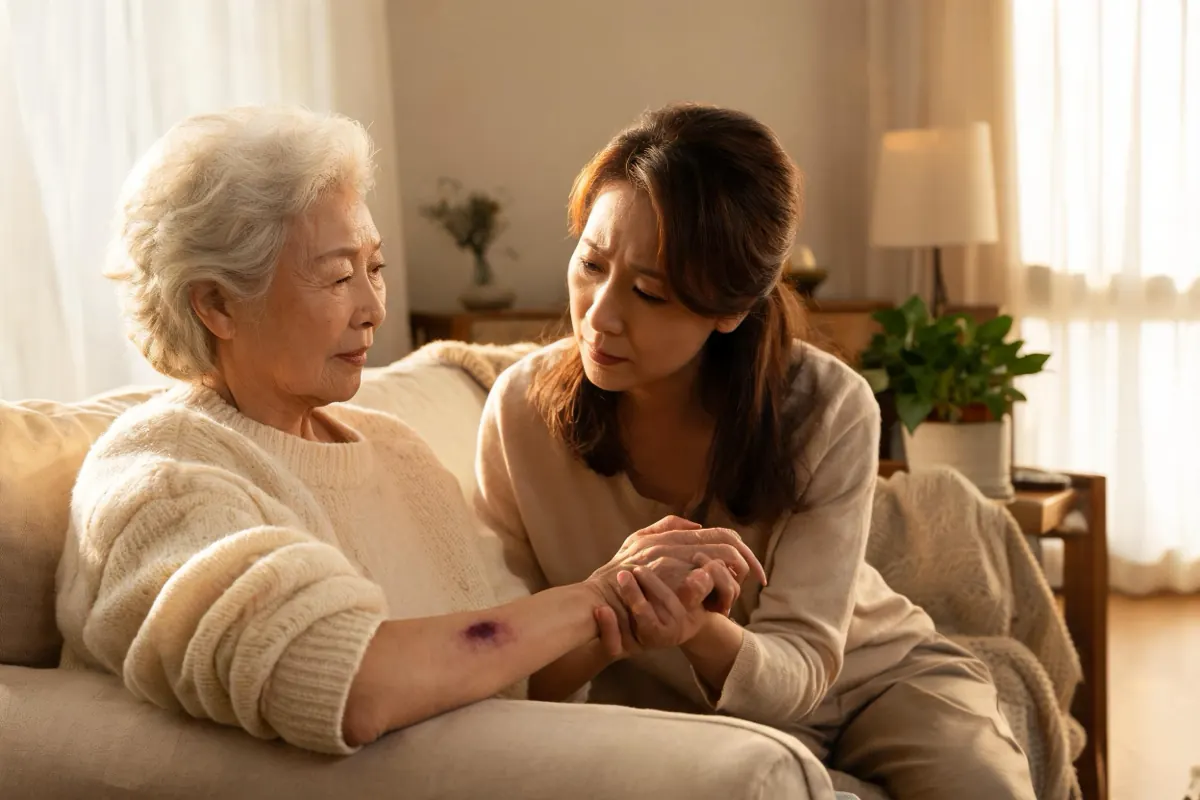
If your parent's skin "tears like paper", you're not imagining it. Skin tears are among the most common wounds in older adults, both in care homes and at home — and among the most preventable.
Why older skin tears so easily
Several age-related changes add up [6]:
- Thinner top layer and dermis. There is simply less tissue to absorb a knock.
- Flatter junction between the layers. In young skin, the epidermis and dermis interlock like fingers. With age the connection flattens, so shear forces can slide them apart [2].
- Less collagen and elastin. Skin stretches less and springs back less.
- Less moisture and fat. Dry skin is more brittle; the fat padding underneath shrinks.
- Fragile blood vessels. That's why skin tears often sit next to bruises or purple patches.
Doctors sometimes group these changes under the term dermatoporosis — "chronic skin fragility" — in which bruising, purple patches and skin tears are all signs of the same underlying weakness [7].
How common are they?
In a 2020 prospective study in Canadian long-term care, 20.8% of 380 residents aged 65+ had a skin tear at the start, and 18.9% developed a new one within four weeks [1]. Skin tears are also frequent among people living at home, but many are never reported.
Who is most at risk?
A systematic review identified these recurring risk factors [3]:
| Risk factor | Why it matters |
|---|---|
| Previous skin tears | The skin is already fragile; repeat tears are common |
| Needing help to move, wash or dress | Hands grip arms; shear forces during transfers |
| Falls and poor balance | Knocks against furniture and floors |
| Dementia or agitation | Knocks, resisting care, scratching |
| Dry skin, purpura, bruising | Visible signs of fragile skin |
| Long-term steroids | Thin the skin further |
| Blood thinners | Heavier bleeding when a tear happens |
| Poor nutrition, dehydration | Slower repair |
Where skin tears happen
Mostly on the forearms, backs of the hands and shins — places that bump into things and get gripped during help with moving. Typical moments: getting in and out of bed or a car, moving into a wheelchair, dressing, bathing, and removing plasters or tape.
What families and caregivers can do
Our full prevention checklist is here: how to prevent skin tears in the elderly. The essentials:
- Moisturize twice a day. In a cluster-randomized trial across 14 Australian aged-care facilities, twice-daily moisturizer on the limbs cut skin tears from 10.57 to 5.76 per 1,000 occupied bed days [4].
- Cover the limbs. Long soft sleeves, trousers, knee-high socks or padded protectors.
- Handle gently. Never pull or lift by the arms or wrists; support under the shoulders and use slide sheets.
- Pad the environment. Bed rails, wheelchair arms and footplates, sharp furniture edges.
- No tape on skin. Silicone tape or tubular bandages only.
- Short nails and no sharp rings — for both the person and the helper.
- Food and fluids. Enough protein and water every day; skin repair slows with age [9].
If a skin tear happens
Stop the bleeding with gentle pressure, rinse, ease the flap back, and use a non-stick silicone dressing held without tape. Step-by-step: how to treat a skin tear. In care homes, ISTAP recommends documenting the type and size, and reviewing what caused it so it doesn't happen again [5].
Is a skin tear a sign of neglect?
Not by itself. Skin tears often happen even with very good care, because aging skin is so fragile. But repeated unexplained wounds, injuries in unusual places, or explanations that don't add up deserve a calm conversation with the care team and, if needed, the doctor. See unexplained bruising in an elderly parent.
Frequently asked questions
Why does elderly skin tear so easily?
Aging skin is thinner, drier and less elastic, and the bond between its layers weakens. A light knock, friction or pulling on the arm can separate the layers and cause a tear.
Are skin tears common in the elderly?
Yes. In one long-term care study, about 1 in 5 residents had a skin tear and nearly as many developed a new one within four weeks.
How do you prevent skin tears in elderly people?
Moisturize arms and legs twice daily, cover limbs with soft clothing or protectors, avoid tape, pad sharp edges and never lift by the arms. Moisturizing alone cut skin tears by almost half in a trial.
Do skin tears in the elderly heal?
Most do, usually within two to four weeks with good care. Larger tears, infections, diabetes or poor circulation can slow healing.
Sources
- LeBlanc K, et al. Skin tear prevalence and incidence in the long-term care population: a prospective study. Journal of Wound Care, 2020. PubMed 32654616
- LeBlanc K, Baranoski S, et al. Skin tears: state of the science: consensus statements for the prevention, prediction, assessment, and treatment of skin tears. Advances in Skin & Wound Care, 2011. PubMed 21876389
- Serra R, et al. Skin tears and risk factors assessment: a systematic review on evidence-based medicine. International Wound Journal, 2018. PubMed 29045078
- Carville K, et al. The effectiveness of a twice-daily skin-moisturising regimen for reducing the incidence of skin tears. International Wound Journal, 2014. PubMed 25040325
- LeBlanc K, Campbell KE, Wood E, Beeckman D Best Practice Recommendations for Prevention and Management of Skin Tears in Aged Skin: An Overview. Journal of Wound, Ostomy and Continence Nursing, 2018. PubMed 30395131
- Aging changes in skin — MedlinePlus Medical Encyclopedia.
- Kaya G, Saurat JH Dermatoporosis: a chronic cutaneous insufficiency/fragility syndrome. Dermatology, 2007. PubMed 17911985
- Lichterfeld-Kottner A, et al. Maintaining skin integrity in the aged: A systematic review. International Journal of Nursing Studies, 2020. PubMed 31945604
- Gosain A, DiPietro LA Aging and wound healing. World Journal of Surgery, 2004. PubMed 14961191
General information, not medical advice. Written by the Reunoa editorial team; Reunoa makes Bruise Defense & Repair Serum. See our editorial policy for how we pick sources and keep product mentions fair.