Dermatoporosis: what "chronic skin fragility" means
 By Margaret Hale, Reunoa EditorialLast updated
The short answer
Dermatoporosis (der-ma-to-po-ROE-sis) is a term proposed for chronic skin fragility in older adults — the skin equivalent of osteoporosis. Its visible signs are very thin skin, senile purpura and white star-shaped scars; its functional signs are frequent skin tears, slow healing and wounds that won't close after minor injuries. Aging, sun and long-term steroids are the main causes.
Key takeaways
- Proposed term for "chronic cutaneous insufficiency/fragility syndrome" [1].
- Visible markers: skin atrophy, senile purpura, stellate pseudoscars [1].
- Functional signs: frequent tears, delayed healing, non-healing wounds [1].
- Causes: chronological aging, sun exposure, long-term steroids [1] [3].
- Twice-daily moisturizing halved skin tears in older adults [5].
Definition
Dermatoporosis is a term proposed in the dermatology literature to describe the full picture of chronic skin fragility in older people — a "chronic cutaneous insufficiency/fragility syndrome" [1]. The name deliberately echoes osteoporosis: just as bones become porous and break easily, skin becomes thin and tears easily.
Pronunciation: der-ma-to-po-ROE-sis.
Signs
| Type | Signs [1] |
|---|---|
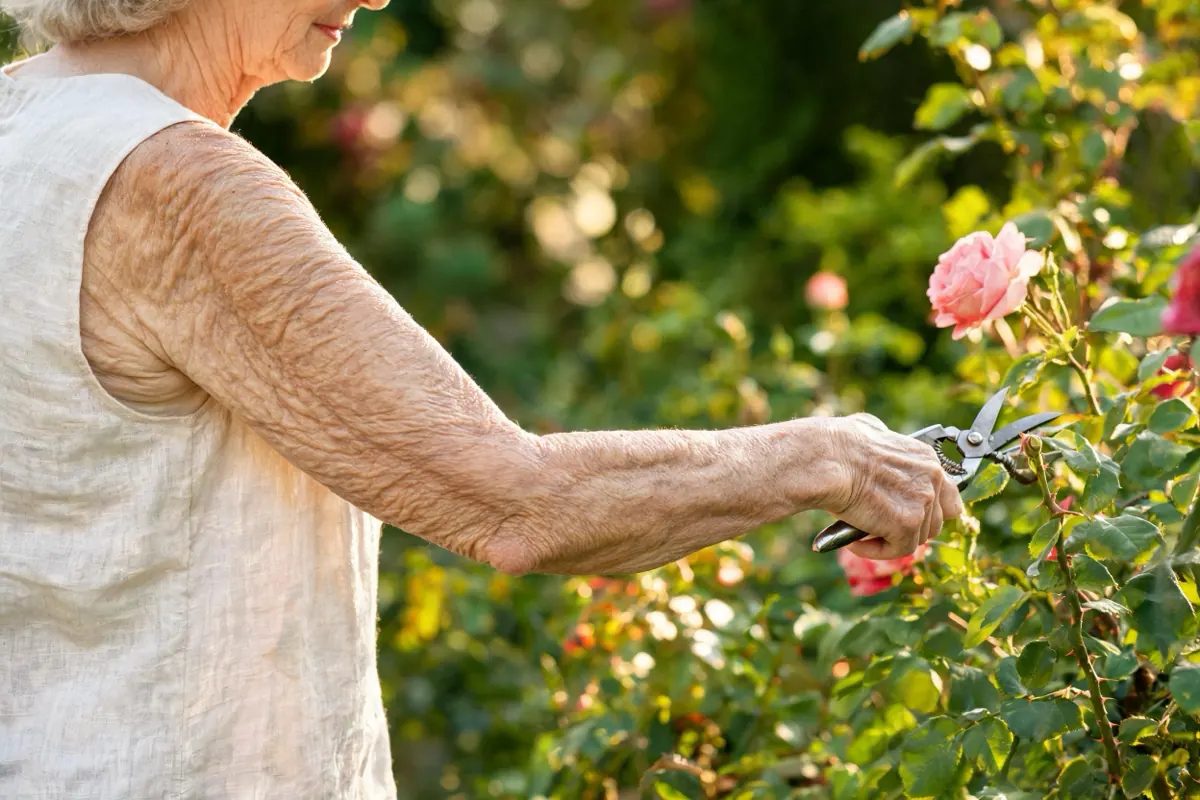
| Visible (morphological) | Very thin, translucent skin (atrophy) · senile purpura — flat purple patches · stellate pseudoscars — white, star-shaped scars on forearms |
| Functional | Skin tears from minor bumps · delayed wound healing · non-healing wounds after small injuries · deep dissecting hematomas (rare, serious) |
Senile purpura is often the first sign people notice; it affects more than 10% of people over 50 [2].
Causes
- Chronological aging — thinner skin, less collagen and fat padding.
- Sun exposure — UV breaks down collagen and elastic fibres [4].
- Long-term corticosteroids — topical, oral or inhaled steroids can thin skin [3].
- Genetic and individual factors — some people's skin thins faster.
Why it matters
Dermatoporosis isn't just cosmetic. Skin tears are common in older adults — about 1 in 5 long-term care residents had one in a 2020 study [8] — and they hurt, take weeks to heal and can become infected. Naming the condition helps doctors and families take prevention seriously.
What helps
| Step | Evidence |
|---|---|
| Moisturize twice daily | Halved skin tears in aged care [5] |
| Daily sunscreen | Slowed skin aging over 4.5 years [6] |
| Topical retinoid (if tolerated) | Increased procollagen in aged skin [7] |
| Protection — sleeves, padding, gentle handling | Fewer knocks and tears |
| Medication review | Lowest effective steroid dose |
Detailed guides: fragile skin · how to thicken thin skin · how to prevent skin tears.
Related terms
Senile purpura · Skin tear · Stellate pseudoscars · Dermis · Petechiae vs purpura vs ecchymosis
Frequently asked questions
What is dermatoporosis?
A term for chronic skin fragility in older adults: thin skin, senile purpura, star-shaped scars, frequent skin tears and slow healing.
What causes dermatoporosis?
Mainly aging, decades of sun exposure and long-term corticosteroid use.
Is dermatoporosis a disease?
It's a descriptive term for a syndrome of skin fragility rather than a single disease. Naming it helps focus on prevention and care.
Can dermatoporosis be treated?
It can be improved and its complications reduced with moisturizing, sun protection, retinoids if tolerated and protecting the skin from injury.
Sources
- Kaya G, Saurat JH Dermatoporosis: a chronic cutaneous insufficiency/fragility syndrome. Dermatology, 2007. PubMed 17911985
- Senile purpura — DermNet (New Zealand).
- Barnes L, et al. Topical corticosteroid-induced skin atrophy: a comprehensive review. Drug Safety, 2015. PubMed 25862024
- Rittié L, Fisher GJ Natural and sun-induced aging of human skin. Cold Spring Harbor Perspectives in Medicine, 2015. PubMed 25561721
- Carville K, et al. The effectiveness of a twice-daily skin-moisturising regimen for reducing the incidence of skin tears. International Wound Journal, 2014. PubMed 25040325
- Hughes MC, et al. Sunscreen and prevention of skin aging: a randomized trial. Annals of Internal Medicine, 2013. PubMed 23732711
- Kafi R, et al. Improvement of naturally aged skin with vitamin A (retinol). Archives of Dermatology, 2007. PubMed 17515510
- LeBlanc K, et al. Skin tear prevalence and incidence in the long-term care population: a prospective study. Journal of Wound Care, 2020. PubMed 32654616
General information, not medical advice. Written by the Reunoa editorial team; Reunoa makes Bruise Defense & Repair Serum. See our editorial policy for how we pick sources and keep product mentions fair.