Fragile skin: why it happens and a care plan that works
 By Margaret Hale, Reunoa EditorialLast updated
The short answer
Fragile skin is skin that bruises, tears and heals slowly because it has become thin, dry and poorly supported — mostly from aging and sun, sometimes steroids. Doctors call the full picture "dermatoporosis". The best-evidenced care is twice-daily moisturizing (halved skin tears in a trial), daily sunscreen, topical retinoids where tolerated, protective clothing and gentle handling.
Key takeaways
- Dermatoporosis describes chronic skin fragility with purpura, scars and tears [1].
- Main causes: aging, sun, long-term steroids [2] [3] [4].
- Twice-daily moisturizer cut skin tears by almost half in aged care [5].
- Daily sunscreen slowed skin aging over 4.5 years [6].
- Structured skin-care routines improve dryness and barrier function in older adults [7].
On this page
In our anonymous survey of more than 7,600 US adults aged 55+, skin that bruises or marks easily was one of the most common worries — see the Fragile Skin Report 2027 [10]. Fragile skin is common, under-discussed and very manageable.
What "fragile skin" means
Fragile skin isn't one disease. It's a set of signs that the skin's structure has weakened. A dermatology paper proposed the term dermatoporosis — "chronic cutaneous insufficiency" — to capture it, comparing it to osteoporosis for bones [1]. Signs include:
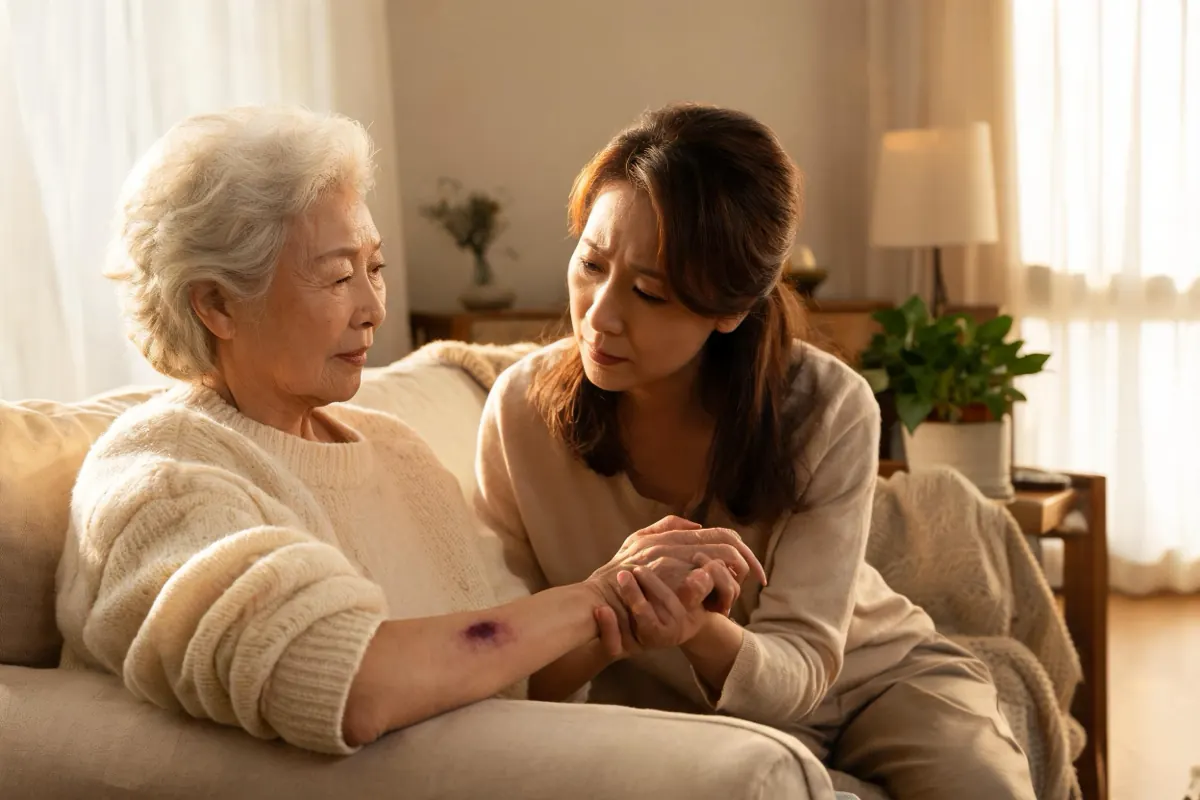
- Visible markers: senile purpura, white star-shaped scars (stellate pseudoscars), thin translucent skin
- Functional fragility: frequent skin tears, slow wound healing, non-healing wounds after minor injuries
Why skin becomes fragile
- Aging — less collagen and fat, thinner layers, slower repair [2]
- Sun — UV breaks down collagen and elastin [3]
- Steroids — long-term topical, oral or inhaled steroids [4]
- Dryness — brittle skin cracks and tears
- Medicines that increase bleeding — blood thinners make fragility more visible
Warning signs it's getting worse
- more skin tears from smaller bumps
- wounds taking longer than 3–4 weeks to heal
- new purple patches most days
- brown staining building up on forearms
In long-term care, about 1 in 5 residents had a skin tear in one study [9] — fragile skin is a real care issue, not vanity.
A care plan that works
| Step | Evidence |
|---|---|
| Moisturize arms and legs twice daily | Halved skin tears in a randomized trial [5] |
| Gentle cleansers, no harsh soap | Syndet cleansers improve dryness [7] |
| Daily broad-spectrum sunscreen | Slowed skin aging over 4.5 years [6] |
| Topical retinoid if tolerated | Increased procollagen in aged skin [8] |
| Long sleeves, padded protectors | Takes knocks instead of skin |
| Gentle handling, no tape | Prevents tears during care |
| Medication review | Reduces unnecessary steroid or bleeding effects |
Detailed steps: how to thicken thin skin and how to prevent skin tears.
For caregivers
If you help a parent wash, dress or move: roll sleeves up before guiding arms through, support under the shoulders rather than gripping arms, keep your nails short and remove rings. Keep silicone dressings at home in case of a tear.
Fragile skin and medicines
Several common medicines make fragile skin more noticeable. Steroids thin the skin itself. Blood thinners and antiplatelets don't thin skin but make every leak bigger, so fragility shows as large purple patches. NSAIDs and some supplements add a little bleeding tendency. A yearly review with your doctor or pharmacist — bringing every pill, cream and supplement — is one of the most useful steps you can take. Never stop a prescribed medicine on your own.
Frequently asked questions
What causes fragile skin in the elderly?
Mainly aging and sun damage, which thin the skin and weaken its support. Long-term steroids and dryness add to it.
What is dermatoporosis?
A term for chronic skin fragility, with signs such as senile purpura, white star-shaped scars, thin skin, frequent tears and slow healing.
How do you treat fragile skin?
Twice-daily moisturizing, daily sunscreen, topical retinoids if tolerated, protective clothing, gentle handling and reviewing medicines that thin skin.
Can fragile skin get better?
Yes, to a degree. Skin can become more resilient over months with consistent care, and the rate of tears and bruises can drop.
Is fragile skin the same as thin skin?
Mostly. Thin skin is the main cause of fragile skin, but dryness, steroid use and fragile blood vessels also contribute. "Fragile" describes how the skin behaves — bruising and tearing — rather than just its thickness.
Sources
- Kaya G, Saurat JH Dermatoporosis: a chronic cutaneous insufficiency/fragility syndrome. Dermatology, 2007. PubMed 17911985
- Aging changes in skin — MedlinePlus Medical Encyclopedia.
- Rittié L, Fisher GJ Natural and sun-induced aging of human skin. Cold Spring Harbor Perspectives in Medicine, 2015. PubMed 25561721
- Barnes L, et al. Topical corticosteroid-induced skin atrophy: a comprehensive review. Drug Safety, 2015. PubMed 25862024
- Carville K, et al. The effectiveness of a twice-daily skin-moisturising regimen for reducing the incidence of skin tears. International Wound Journal, 2014. PubMed 25040325
- Hughes MC, et al. Sunscreen and prevention of skin aging: a randomized trial. Annals of Internal Medicine, 2013. PubMed 23732711
- Lichterfeld-Kottner A, et al. Maintaining skin integrity in the aged: A systematic review. International Journal of Nursing Studies, 2020. PubMed 31945604
- Kafi R, et al. Improvement of naturally aged skin with vitamin A (retinol). Archives of Dermatology, 2007. PubMed 17515510
- LeBlanc K, et al. Skin tear prevalence and incidence in the long-term care population: a prospective study. Journal of Wound Care, 2020. PubMed 32654616
- Fragile Skin Report 2027 — aggregated, anonymous answers from the Reunoa skin quiz — Reunoa Editorial (learn.reunoa.com).
General information, not medical advice. Written by the Reunoa editorial team; Reunoa makes Bruise Defense & Repair Serum. See our editorial policy for how we pick sources and keep product mentions fair.