Petechiae vs purpura vs ecchymosis: what's the difference?
 By Margaret Hale, Reunoa EditorialLast updated
The short answer
Petechiae, purpura and ecchymosis all mean blood has leaked from small vessels into the skin; the main difference is size. Petechiae are pinpoint spots under 4 mm, purpura are 4–10 mm, and ecchymoses (bruises) are larger than 1 cm. None of them fade when pressed. Crops of new petechiae, especially with fever or other bleeding, need a prompt medical check.
Key takeaways
- Petechiae: under 4 mm; purpura: 4–10 mm; ecchymosis: over 1 cm [1].
- All are blood outside the vessels, so they don't blanch under pressure [2].
- Senile purpura patches are technically ecchymoses on fragile, sun-damaged skin [4].
- Raised (palpable) purpura suggests inflamed vessels [3].
- New petechiae with fever or feeling unwell: urgent care.
The short version
| Term | Size | Looks like | Common examples |
|---|---|---|---|
| Petechiae (pe-TEE-kee-eye) | Under 4 mm [1] | Pinpoint red, purple or brown dots | After heavy coughing or vomiting; low platelets; some infections |
| Purpura (PUR-pew-ruh) | 4–10 mm [1] | Small purple spots or patches | Medicines, vessel inflammation, low platelets |
| Ecchymosis (ek-ih-MOE-sis) | Over 1 cm [1] | A bruise | Bumps, blood thinners, senile purpura |
DermNet uses slightly different size cut-offs (petechiae up to 2 mm) [3] — references vary, but the idea is the same: size distinguishes the terms.
What they have in common
All three are blood outside the blood vessels, in the skin. That's why they don't fade (blanch) when you press a clear glass against them, unlike redness from widened vessels [2].
Petechiae
Tiny dots, often in clusters, frequently on the lower legs. A few on the face after straining, coughing or vomiting can be harmless. But crops of new petechiae can signal low platelets [5], infections, medicine reactions or vessel problems — get them checked, urgently if you have fever or feel unwell.
Purpura
Medium-sized purple spots. Doctors also use "purpura" as an umbrella word for any bleeding into the skin, and in names like senile purpura. Two subtypes worth knowing:
- Flat (non-palpable) purpura — from fragile vessels or clotting/platelet problems
- Raised (palpable) purpura — suggests inflamed blood vessels (vasculitis) and needs a doctor's assessment [3]
Ecchymosis
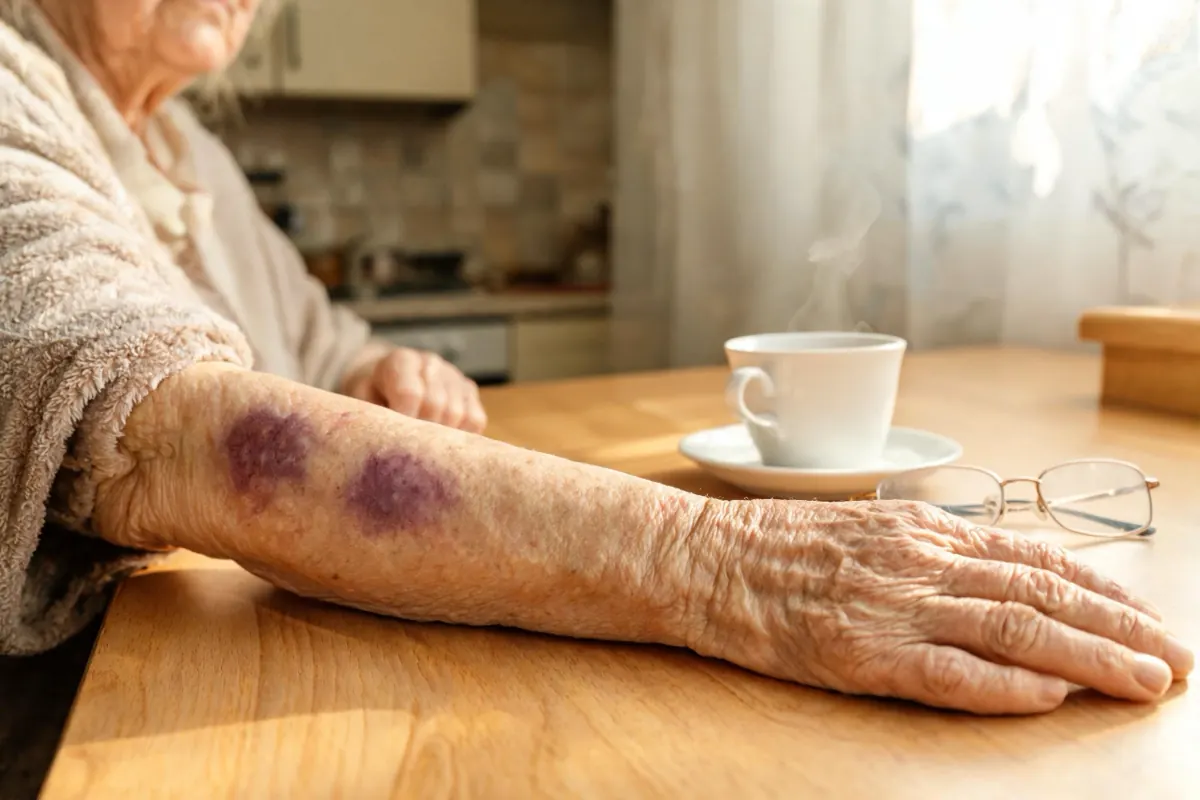
A bruise larger than 1 cm. As it heals, colour typically shifts from purple to green to yellow, though colour can't reliably date it [6]. Senile purpura, despite its name, appears as ecchymoses — 1–4 cm flat patches on sun-damaged forearms [4].
When to see a doctor
Try our purpura check or read blood spots on arms.
Related terms
Purpura · Petechiae · Ecchymosis · Hematoma · Senile purpura · Dermatoporosis
Frequently asked questions
What's the difference between petechiae and purpura?
Size. Petechiae are pinpoint spots under about 4 mm; purpura are larger, roughly 4–10 mm.
Is a bruise the same as an ecchymosis?
Yes. Ecchymosis is the medical term for a bruise larger than about 1 cm.
Are petechiae dangerous?
A few after straining are usually harmless. New crops, especially with fever or other bleeding, can signal a serious problem and need prompt care.
Is senile purpura petechiae?
No. Senile purpura appears as larger flat patches (ecchymoses) on sun-damaged forearms and hands, not pinpoint dots.
Sources
- Purpura — MedlinePlus Medical Encyclopedia.
- Bleeding into the skin — MedlinePlus Medical Encyclopedia (U.S. National Library of Medicine).
- Purpura: causes, types and images — DermNet.
- Senile purpura — DermNet (New Zealand).
- Platelet disorders (thrombocytopenia) — MedlinePlus.
- Langlois NE The science behind the quest to determine the age of bruises — a review of the English language literature. Forensic Science, Medicine and Pathology, 2007. PubMed 25869263
General information, not medical advice. Written by the Reunoa editorial team; Reunoa makes Bruise Defense & Repair Serum. See our editorial policy for how we pick sources and keep product mentions fair.