Blood spots on your arms: what red, purple and pinpoint spots mean
 By Margaret Hale, Reunoa EditorialLast updated
The short answer
Blood spots on the arms are usually harmless in older adults: flat purple patches are typically senile purpura from fragile, sun-damaged skin, and small raised red dots are cherry angiomas. Pinpoint red dots under 4 mm (petechiae) are different — they can signal low platelets or infection and should be checked, especially with fever, tiredness or other bleeding.
Key takeaways
- Doctors sort blood spots by size: petechiae under 4 mm, purpura 4–10 mm, ecchymoses over 1 cm [1].
- Flat purple patches on forearms are usually senile purpura — benign [2].
- Raised red dots that don't fade are usually cherry angiomas — harmless [3].
- Crops of pinpoint dots, especially with fever, need prompt medical care [4].
- Low platelets can cause petechiae and easy bleeding [5].
On this page
"Blood spots" can mean anything from a pinpoint red dot to a palm-sized purple patch. Size, colour and whether the spot is raised tell you a lot about what's going on.
Doctors sort blood spots by size
MedlinePlus uses these terms for bleeding into the skin [1]:
| Term | Size | Example |
|---|---|---|
| Petechiae | Under 4 mm (pinpoint) | Tiny red dots after straining, or with low platelets |
| Purpura | 4–10 mm | Small purple spots |
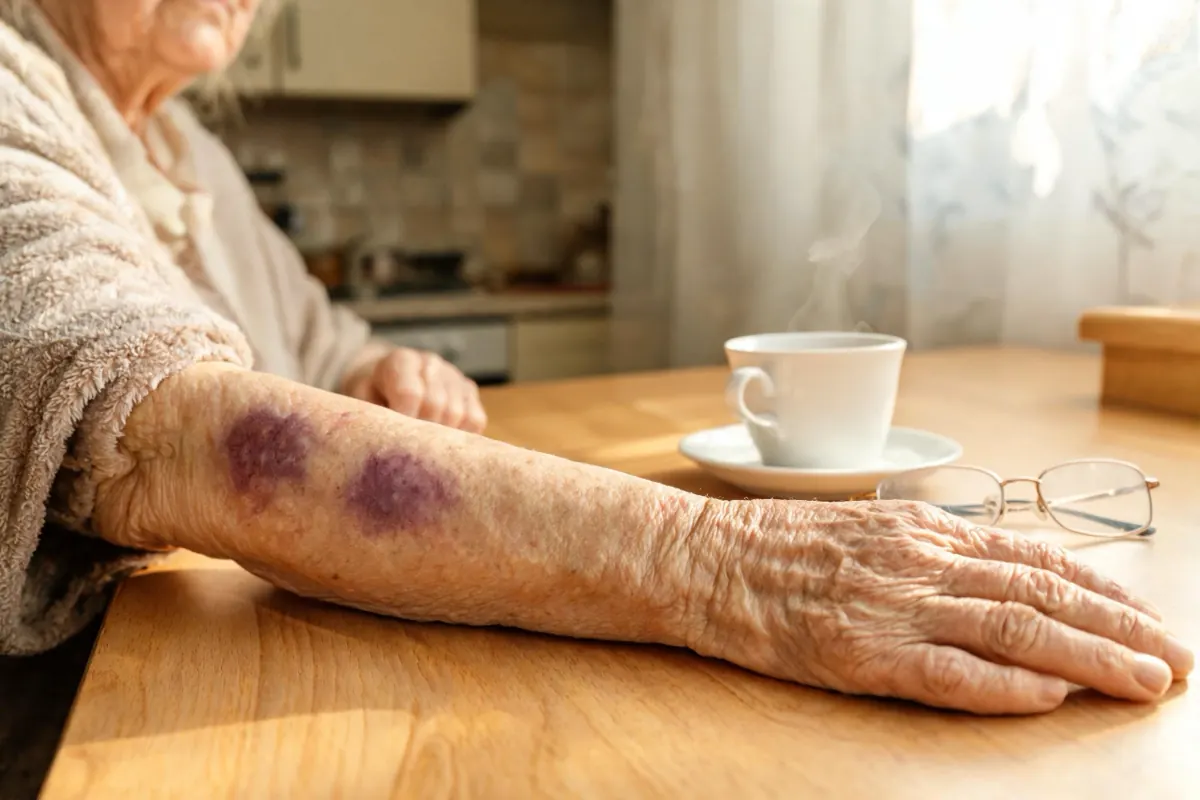
| Ecchymosis | Over 1 cm | A larger bruise or senile purpura patch |
Full explanation: petechiae vs purpura vs ecchymosis.
Common harmless causes
Senile (actinic) purpura
Flat, dark-purple patches 1–4 cm wide with sharp edges on sun-damaged forearms and backs of hands, appearing after minor knocks. Benign; fades over one to three weeks [2]. Guide: senile purpura.
Bruises on blood thinners
Blood thinners and aspirin turn small knocks into larger blood spots [7]. Expected; don't stop the medicine.
Cherry angiomas
Firm, red, blue or purple raised dots 1–10 mm. Harmless and don’t fade [3].
When blood spots need attention
Petechiae
Pinpoint red or purple dots that don't blanch (fade) when you press a glass on them. A few on the face after vomiting or coughing hard can be harmless. But crops of petechiae on the arms or legs can be a sign of low platelets, infection, medicine reactions or other conditions [1] [5].
Raised, itchy or painful purple spots
Palpable purple spots, often on the legs, can be a sign of inflamed small blood vessels (vasculitis) [6].
The glass test
Press the side of a clear drinking glass firmly against the spot:
- Fades under pressure → it's probably a widened vessel or redness, not blood outside the vessels.
- Doesn't fade → blood has leaked into the skin (petechiae, purpura or bruise).
A non-fading rash with fever is a medical emergency.
Quick guide
| Spot | Likely | Action |
|---|---|---|
| Flat, purple, 1–4 cm, forearm | Senile purpura | Protect skin, sun protection |
| Large bruise, on blood thinner | Medicine-related | Note it; mention at next visit |
| Raised bright red dot | Cherry angioma | Harmless; dermatologist can remove if bothersome |
| Pinpoint dots, non-fading | Petechiae | See a doctor |
| Raised, itchy purple spots | Possible vasculitis | See a doctor |
Blood spots and medicines
Many common medicines make blood spots more likely: blood thinners and aspirin, clopidogrel, steroids, and some antidepressants. Supplements such as high-dose fish oil, vitamin E or ginkgo may add a little. Don't stop prescribed medicines because of blood spots — instead, bring a list of everything you take to your next appointment. Doctors can check whether all of them are still needed. See bruising on blood thinners.
Protecting skin that spots easily
- Sunscreen and long sleeves on forearms
- Twice-daily moisturizer
- Gloves for gardening and chores
- Pad sharp corners at home
- Avoid tight watch straps and bag handles on the forearm
Frequently asked questions
What causes small blood spots on arms?
In older adults, mostly senile purpura (flat purple patches) and cherry angiomas (raised red dots). Pinpoint petechiae are less common and should be checked.
Are blood spots on arms a sign of cancer?
Rarely. Blood cancers can cause petechiae and bruising, usually with tiredness, infections, fever or bleeding gums. Flat purple patches on sun-damaged forearms are almost always senile purpura.
What do blood spots on the skin mean?
Blood has leaked from small vessels. Most often this is harmless in older skin. Size, location and other symptoms help determine whether a doctor's check is needed.
How do I get rid of blood spots on my arms?
Senile purpura fades by itself over weeks. Cherry angiomas can be removed by a dermatologist. Petechiae should be investigated rather than treated cosmetically.
Sources
- Purpura — MedlinePlus Medical Encyclopedia.
- Senile purpura — DermNet (New Zealand).
- Cherry angioma — DermNet.
- Bleeding into the skin — MedlinePlus Medical Encyclopedia (U.S. National Library of Medicine).
- Platelet disorders (thrombocytopenia) — MedlinePlus.
- Purpura: causes, types and images — DermNet.
- Blood Thinners — MedlinePlus (U.S. National Library of Medicine).
General information, not medical advice. Written by the Reunoa editorial team; Reunoa makes Bruise Defense & Repair Serum. See our editorial policy for how we pick sources and keep product mentions fair.