Actinic purpura pictures: what it looks like at every stage
 By Margaret Hale, Reunoa EditorialLast updated
The short answer
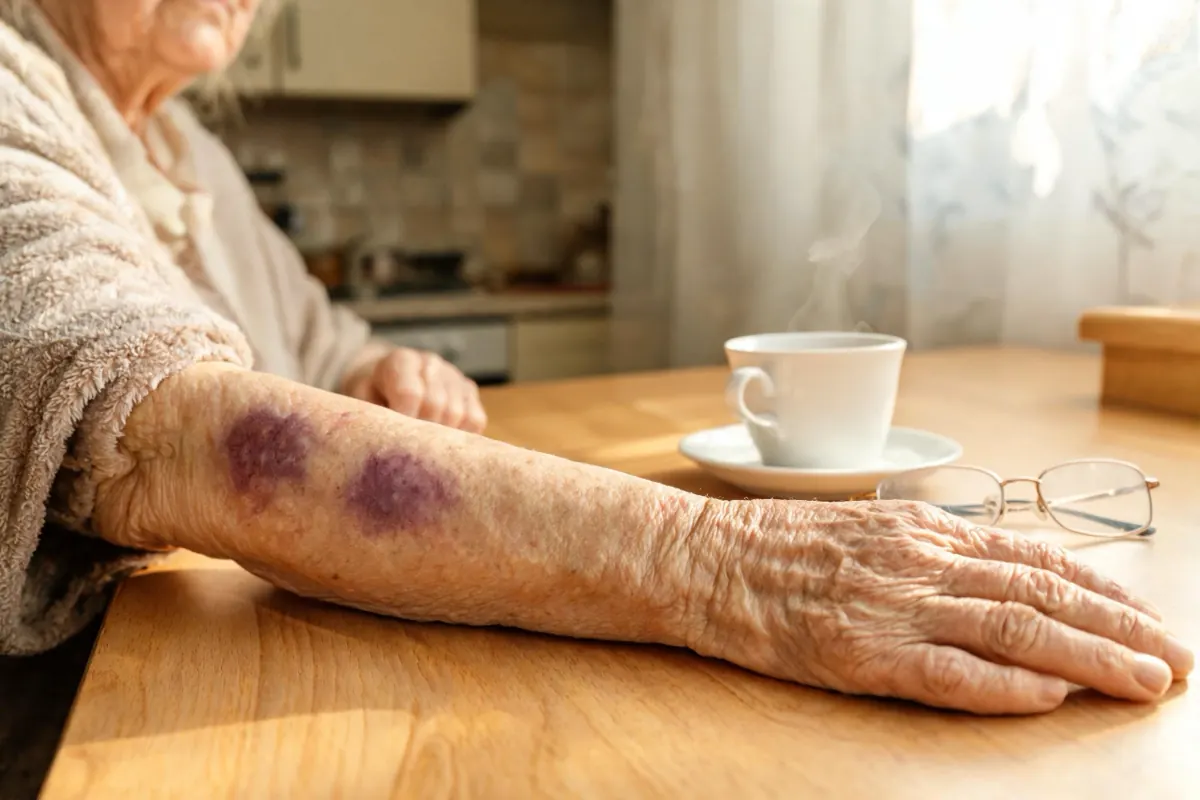
Actinic purpura looks like flat, dark-purple or red-purple patches, 1–4 cm wide, with sharp irregular edges, on the outer forearms and backs of the hands. The surrounding skin is thin, shiny and sun-damaged. Unlike a bruise, patches stay purple rather than turning green and yellow, fade over one to three weeks and often leave a brown stain.
Key takeaways
- Flat, dark-purple patches with sharp edges on sun-exposed forearms and hands [1].
- Typical size 1–4 cm; no swelling, usually painless [1].
- Patches don't go through the rainbow of bruise colours [1].
- Brown hemosiderin staining after fading is common [1].
- Pinpoint red dots (petechiae) or raised spots look different and need a doctor [2].
On this page
People search for pictures because they want to know: "Is this what I have?" Below is a description of what actinic (senile) purpura looks like at each stage, so you can compare it with your own skin. The photo at the top shows a typical example.
The key visual features
DermNet describes actinic/senile purpura as irregularly shaped, flat patches, 1–4 cm in diameter, dark purple with well-defined edges, mostly on the outer forearms and backs of the hands [1]. Look for:
- Flat — run a finger over it; you won't feel a bump
- Sharp, map-like edges — not the soft, fading border of a bruise
- Deep purple or red-purple, sometimes almost black-purple in the middle
- Thin, crinkled, shiny skin around it, often with freckles, age spots or white star-shaped scars
- Several patches at different stages — some fresh, some fading, some brown
Stage by stage
| Stage | Timing | What you see |
|---|---|---|
| Fresh patch | Hours to day 2 | Bright red-purple to deep purple, sharp edges, flat; appears after a minor knock or even rubbing |
| Mature patch | Days 3–10 | Deep purple, may darken; edges stay sharp; no green or yellow phase |
| Fading | Days 10–21 | Patch becomes duller and smaller; colour turns brownish-purple |
| Brown stain | Weeks to months | Rust-brown or tan mark where the patch was, from iron (hemosiderin) left in the skin |
DermNet notes the patches resolve over one to three weeks and may leave residual brown pigmentation [1]. Over years, the brown can build up into a permanent bronze tint on the forearms. More on that: hemosiderin staining.
Where it appears
- Outer (back) side of the forearms — by far the most common
- Backs of the hands
- Less often: the neck, face or shins
Bruises in older adults from everyday accidents also mostly occur on the arms and legs [4], so location alone doesn't distinguish purpura from bruises — the flat, sharp-edged look does.
Look-alikes, described
| Looks like | How it differs |
|---|---|
| Ordinary bruise | Often swollen and tender at first, blurred edges, goes purple → green → yellow |
| Petechiae | Tiny pinpoint dots under 4 mm, red or purple, often on legs; need a doctor's check [2] |
| Cherry angioma | Small, raised, bright red to purple dome, 1–10 mm, doesn't fade [3] |
| Hemosiderin staining | Brown, not purple; usually lower legs; builds up slowly |
| Raised, itchy or painful purple spots | May be inflammation of the vessels (vasculitis) — see a doctor [2] |
Take your own "pictures" to track it
Photos are useful for you and your doctor:
- Photograph the same area in daylight once a week.
- Put a coin or ruler next to patches for scale.
- Note any new medicine, knock or symptom.
This helps show whether patches follow the typical pattern (appear, stay purple, fade in 1–3 weeks) — or not.
Frequently asked questions
What does actinic purpura look like?
Flat, dark-purple patches with sharp, irregular edges, 1–4 cm across, on thin, sun-damaged forearms and hands. They stay purple rather than changing colours like a bruise.
Is actinic purpura raised?
No. It is flat. Raised purple spots are a different condition and should be checked by a doctor.
Why does actinic purpura leave brown marks?
As the leaked blood breaks down, iron in the form of hemosiderin can stay in the skin and leave a brown stain that fades slowly.
How can I tell senile purpura from a bruise in a photo?
Senile purpura has sharp edges, is flat, and stays deep purple. A bruise has blurred edges and changes colour through blue, green and yellow as it heals.
Sources
- Senile purpura — DermNet (New Zealand).
- Purpura — MedlinePlus Medical Encyclopedia.
- Cherry angioma — DermNet.
- Mosqueda L, Burnight K, Liao S The life cycle of bruises in older adults. Journal of the American Geriatrics Society, 2005. PubMed 16078959
- Bleeding into the skin — MedlinePlus Medical Encyclopedia (U.S. National Library of Medicine).
General information, not medical advice. Written by the Reunoa editorial team; Reunoa makes Bruise Defense & Repair Serum. See our editorial policy for how we pick sources and keep product mentions fair.