Actinic purpura (solar purpura): why the sun leaves purple patches on your arms
 By Margaret Hale, Reunoa EditorialLast updated
The short answer
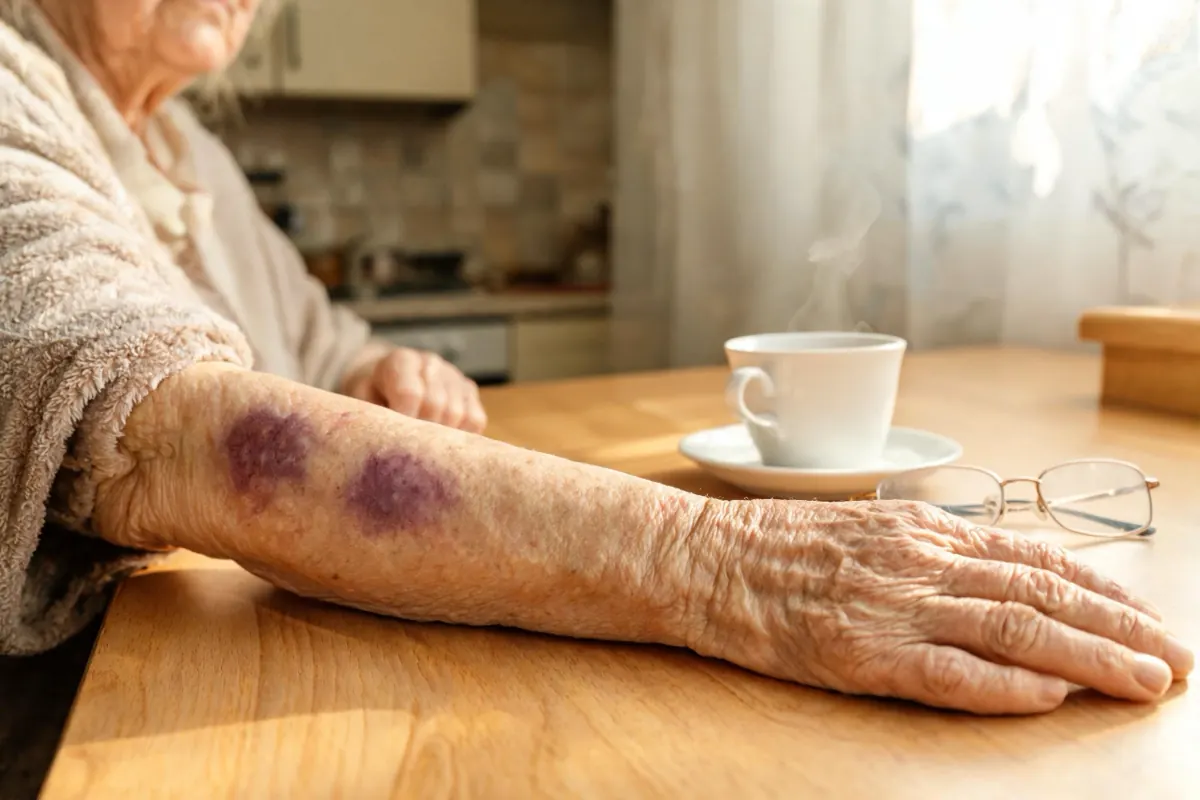
Actinic purpura — also called solar, senile or Bateman purpura — is a harmless condition in which flat, dark-purple patches 1–4 cm wide appear on sun-damaged forearms and hands after minor knocks. Years of sun weaken the collagen that supports small blood vessels, so they tear easily. Patches fade over one to three weeks, often leaving brown stains.
Key takeaways
- "Actinic", "solar", "senile" and "Bateman" purpura are the same condition [1].
- It affects more than 10% of people over 50, men and women equally [1].
- The cause is sun-damaged, thinned dermis with fragile vessels — not a blood disorder [1] [2].
- Patches don't go through the usual bruise colours and fade over 1–3 weeks, often leaving brown hemosiderin marks [1].
- Sun protection is the core advice; a citrus bioflavonoid supplement reduced new lesions in one trial [4].
On this page
If your forearms are covered in purple blotches that appear after the lightest bump — a doorframe, a sleeve, a grandchild's hug — and you've spent decades outdoors, you are probably looking at actinic purpura.
One condition, four names
Doctors use several names for the same thing [1]:
- Actinic purpura — "actinic" means caused by sunlight
- Solar purpura — the same idea
- Senile purpura — the older term, meaning "of old age" (not dementia)
- Bateman purpura — after Thomas Bateman, who described it in 1818
We use "actinic" and "senile" interchangeably on this site. Our complete guide is here: senile purpura.
Why the sun causes it
Ultraviolet light breaks down collagen and elastic fibres in the dermis, the layer that cushions and supports small blood vessels [2]. Over decades, the forearms and backs of the hands — the most sun-exposed skin after the face — become thin and lose that support. DermNet describes the result: thin dermis, reduced collagen replaced by abnormal elastic fibres, and blood vessels that "tear and rupture even with negligible trauma" [1].
Blood leaks into the surrounding skin and creates a flat purple patch. The vessel walls themselves are normal, and blood clotting tests are usually normal too.
What it looks like
- Flat, not raised, with sharp, irregular edges
- Dark purple to red-purple, 1–4 cm across
- On the outer forearms and backs of the hands, sometimes neck or face
- Surrounding skin is thin, shiny, wrinkled or freckled — signs of sun damage
- No swelling and usually no pain
- Doesn't go through the green-yellow stages of a normal bruise [1]
- Often leaves a brown stain as it fades
See actinic purpura pictures (described) for a stage-by-stage description.
Who gets it
More than 1 in 10 people over 50, equally men and women. Risk is higher with lifelong sun exposure, fair skin, long-term oral or topical steroids, and blood thinners [1].
Actinic purpura vs a normal bruise
| Actinic purpura | Normal bruise | |
|---|---|---|
| Cause | Very minor friction or knock | A noticeable bump |
| Shape | Flat, sharp irregular edges | Often raised or swollen, blurred edges |
| Colour change | Stays purple, then fades to brown | Purple → blue → green → yellow |
| Pain | Usually painless | Often tender |
| Location | Forearms, backs of hands | Anywhere |
| Leftover | Brown stain common | Usually fades completely |
More detail: senile purpura vs bruise.
Is it dangerous?
No. DermNet describes it as benign and unrelated to systemic disease or blood disorders. It is, however, a sign of fragile skin and a risk factor for skin tears [1]. See is senile purpura dangerous? for red flags that point to something else.
What helps
- Sun protection — sunscreen on forearms and hands, long sleeves outdoors. This is the main medical advice [1].
- Moisturize twice a day — keeps fragile skin supple; twice-daily moisturizing cut skin tears by almost half in older adults [8].
- Topical ingredients — a review discusses combining retinol, alpha-hydroxy acids, arnica, ceramides and vitamin K for actinic purpura (the review was funded by a purpura-cream maker) [7]. Individually, 20% arnica [5] and vitamin K [6] helped bruises fade in controlled studies; retinol improved naturally aged skin [9].
- Citrus bioflavonoids — in a randomized, placebo-controlled trial, a citrus bioflavonoid supplement reduced new purpura lesions by 50% after six weeks [4]. Ask your pharmacist first.
- Protect your arms from bumps with light sleeves and padded edges.
Full options: senile purpura treatment.
Frequently asked questions
What is the difference between actinic purpura and senile purpura?
There is none — they are two names for the same condition. "Actinic" refers to the sun damage that causes it; "senile" refers to the age group it affects.
Is solar purpura the same as actinic purpura?
Yes. Solar, actinic, senile and Bateman purpura all describe flat purple patches on sun-damaged, aging skin.
Can actinic purpura be cured?
The underlying sun damage can't be fully reversed, but sun protection, moisturizing, topical ingredients and protecting your arms can reduce new patches and help existing ones fade.
Does actinic purpura go away?
Each patch fades over one to three weeks, though new ones can keep appearing. Brown stains may remain for weeks or months.
Sources
- Senile purpura — DermNet (New Zealand).
- Rittié L, Fisher GJ Natural and sun-induced aging of human skin. Cold Spring Harbor Perspectives in Medicine, 2015. PubMed 25561721
- Purpura — MedlinePlus Medical Encyclopedia.
- Berlin JM, et al. A randomized, placebo-controlled, double-blind study to evaluate the efficacy of a citrus bioflavanoid blend in the treatment of senile purpura. Journal of Drugs in Dermatology, 2011. PubMed 21720653
- Leu S, et al. Accelerated resolution of laser-induced bruising with topical 20% arnica: a rater-blinded randomized controlled trial. British Journal of Dermatology, 2010. PubMed 20412090
- Shah NS, et al. The effects of topical vitamin K on bruising after laser treatment. Journal of the American Academy of Dermatology, 2002. PubMed 12140470
- Ceilley RI Treatment of Actinic Purpura. Journal of Clinical and Aesthetic Dermatology, 2017. PubMed 28979656
- Carville K, et al. The effectiveness of a twice-daily skin-moisturising regimen for reducing the incidence of skin tears. International Wound Journal, 2014. PubMed 25040325
- Kafi R, et al. Improvement of naturally aged skin with vitamin A (retinol). Archives of Dermatology, 2007. PubMed 17515510
General information, not medical advice. Written by the Reunoa editorial team; Reunoa makes Bruise Defense & Repair Serum. See our editorial policy for how we pick sources and keep product mentions fair.