Arnica cream for bruises: what the evidence says about strength, results and safety
 By Margaret Hale, Reunoa EditorialLast updated
The short answer
Arnica cream can help bruises fade faster — but strength matters. In a rater-blinded randomized trial, 20% arnica ointment sped the fading of laser-induced bruises compared with placebo, while highly diluted homeopathic arnica did not beat placebo after eyelid surgery. Look for a clearly stated arnica percentage, use it on unbroken skin twice daily, and patch-test first if you're allergic to daisies.
Key takeaways
- 20% arnica ointment improved bruises more than placebo in a randomized trial [1].
- Homeopathic arnica didn't reduce bruising after eyelid surgery [2].
- A systematic review found mixed results for arnica overall, mostly from oral homeopathic products [3].
- Arnica gel performed similarly to ibuprofen gel for hand osteoarthritis pain [4].
- Allergy is the main risk, especially with daisy-family allergies [5] [6].
On this page
- What is arnica?
- Does arnica cream work for bruises?
- How to read an arnica label
- How to use arnica cream on bruises
- Side effects and who should avoid it
- Arnica and blood thinners
- Arnica vs vitamin K
- Arnica for senile purpura
- Arnica for older skin: practical tips
- Is arnica cream a drug or a cosmetic?
- Frequently asked questions
Arnica is the most famous bruise remedy in the world. Walk into any pharmacy and you'll find it in gels, creams, pellets and oils. Yet the evidence is confusing — some studies say it works, others say it doesn't. The explanation is almost always the same: which kind of arnica, and how much.
What is arnica?
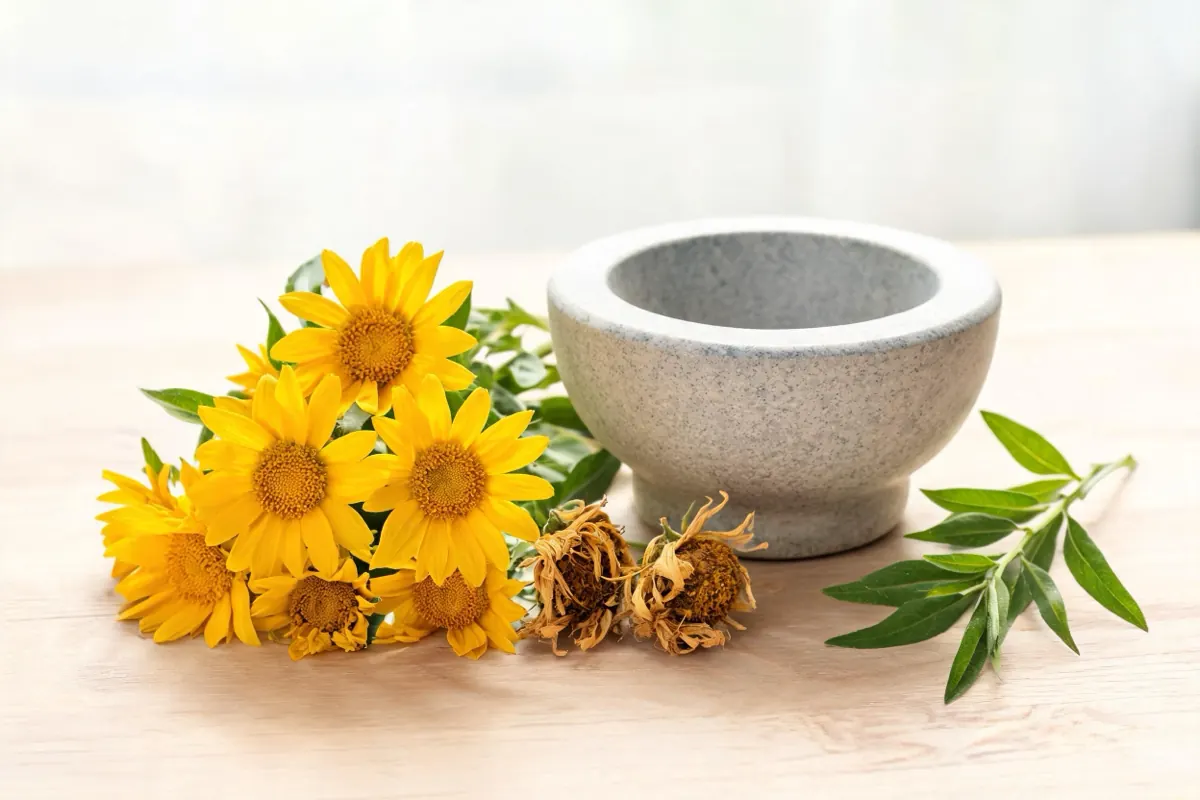
Arnica montana is a yellow mountain flower from the daisy family (Asteraceae). Its extracts contain sesquiterpene lactones such as helenalin, which have anti-inflammatory effects. It has been used on bruises and sprains for centuries. Taken by mouth as a herbal extract it can be toxic, which is why oral arnica is sold almost only as highly diluted homeopathic pellets [7].
Does arnica cream work for bruises?
The positive trial: 20% arnica
In a rater-blinded randomized controlled trial, volunteers had bruises created with a laser and then applied either 20% arnica ointment, 5% vitamin K cream, a 1% vitamin K + 0.3% retinol mix, or petrolatum (placebo) twice daily under occlusion for two weeks. 20% arnica reduced bruising more than placebo and more than the low-concentration vitamin K/retinol mix; it was not better than 5% vitamin K [1].
The negative trial: homeopathic arnica
After upper eyelid surgery, homeopathic arnica didn't reduce bruising compared with placebo [2]. Homeopathic products are diluted so far that little or no arnica remains.
The review: mixed results
A systematic review of arnica and bromelain for bruising and swelling after procedures found 13 arnica trials — 11 of them with oral (mostly homeopathic) arnica — and concluded that results were mixed and the data insufficient to recommend it routinely [3].
Bottom line
| Type | Evidence for bruises |
|---|---|
| Topical arnica at a meaningful concentration (e.g. 20%) | Positive randomized trial [1] |
| Homeopathic arnica (pellets, "30C") | Didn't beat placebo [2] |
| Homeopathic gels ("1X 7%") | Little direct bruise evidence; "1X" is a 1:10 dilution of tincture |
None of these trials studied everyday bruises in people over 70 or on blood thinners. Results are encouraging for high-strength topical arnica, not a guarantee.
How to read an arnica label
- "15%" or "20% arnica" — percentage of arnica extract in the product. Closest to what was tested in the positive trial.
- "Arnica montana 1X HPUS 7%" — homeopathic notation: 7% of the product is a 1:10 dilution of arnica tincture. The actual amount of arnica is much lower than "7%" suggests.
- "30C" — diluted 1:100, thirty times; effectively no arnica molecules remain.
- "Arnica extract" with no percentage — strength unknown.
More detail: homeopathic arnica vs arnica extract and arnica percentage explained.
How to use arnica cream on bruises
- Start early — within the first day or two after a bruise appears.
- Apply a thin layer twice daily on unbroken skin, gently, without massaging hard.
- Continue until it fades — in the trial, twice daily for two weeks [1]. (Trial volunteers were aged 21–65 and bruises were laser-induced on the upper inner arm.)
- Never on open wounds, skin tears or broken skin.
- Wash hands afterwards and keep away from eyes and mouth.
Side effects and who should avoid it
- Allergy is the main risk. People allergic to ragweed, chamomile, marigold, chrysanthemum or sunflower are more likely to react [5]; allergic contact dermatitis to arnica is documented, especially with strong tinctures [6]. Patch-test on the inner forearm for 24–48 hours.
- Broken skin — avoid.
- Pregnancy or breastfeeding — ask your doctor.
- Oral arnica (not homeopathic) — avoid; it can be toxic [7].
Arnica and blood thinners
Topical arnica on unbroken skin acts locally and is generally considered low risk, but herb databases caution about combining arnica with anticoagulants, noting the clinical relevance is unknown [7]. Ask your pharmacist. Full guide: is arnica safe with blood thinners?
Arnica vs vitamin K
Both were tested in the same trial: 20% arnica beat placebo and a 1% vitamin K/retinol mix, but was not better than 5% vitamin K cream [1]. Another controlled study found vitamin K cream reduced bruise severity after laser treatment [8]. Many products combine both. See arnica vs vitamin K.
Arnica for senile purpura
No trial has tested arnica on senile purpura specifically. A review discusses arnica as part of a combination approach for actinic purpura, alongside retinol, ceramides and vitamin K; it was industry-funded [9].
Arnica for older skin: practical tips
- Choose a gentle base — alcohol-heavy gels can dry thin forearm skin; creams or serums are often better tolerated.
- Apply after washing, on dry skin, then let it absorb before sleeves go on.
- Combine with protection — arnica helps bruises fade but doesn't prevent new knocks.
- Be consistent — twice daily for two weeks matched the positive trial's schedule.
Is arnica cream a drug or a cosmetic?
In the US, products that claim to treat bruises are drugs, while products for appearance are cosmetics [10]. Homeopathic arnica products are sold under homeopathic drug rules; arnica serums like ours are cosmetics that help the look of bruises fade.
Frequently asked questions
Does arnica really work on bruises?
High-strength topical arnica (20%) helped bruises fade faster than placebo in a randomized trial. Homeopathic arnica didn't beat placebo for post-surgical bruising.
What percentage of arnica is best for bruises?
The positive trial used 20% arnica ointment. Products with a clearly stated, meaningful percentage are closer to that than homeopathic "1X" or "30C" products.
How long does arnica take to work on a bruise?
In the trial, arnica was applied twice daily for two weeks, with bruises fading faster than placebo over that period.
Can I use arnica on an open wound?
No. Use arnica only on unbroken skin.
Is arnica gel or cream better?
The base matters less than the concentration. Gels often contain alcohol, which can dry thin skin; creams and serums may be gentler for older skin.
Sources
- Leu S, et al. Accelerated resolution of laser-induced bruising with topical 20% arnica: a rater-blinded randomized controlled trial. British Journal of Dermatology, 2010. PubMed 20412090
- Kotlus BS, et al. Evaluation of homeopathic Arnica montana for ecchymosis after upper blepharoplasty: a placebo-controlled, randomized, double-blind study. Ophthalmic Plastic and Reconstructive Surgery, 2010. PubMed 20683279
- Ho D, et al. Is There a Role for Arnica and Bromelain in Prevention of Post-Procedure Ecchymosis or Edema? A Systematic Review of the Literature. Dermatologic Surgery, 2016. PubMed 27035499
- Widrig R, et al. Choosing between NSAID and arnica for topical treatment of hand osteoarthritis in a randomised, double-blind study. Rheumatology International, 2007. PubMed 17318618
- Gordon LA Compositae dermatitis. Australasian Journal of Dermatology, 1999. PubMed 10439521
- Hörmann HP, Korting HC Allergic acute contact dermatitis due to Arnica tincture self-medication. Phytomedicine, 1995. PubMed 23196021
- Arnica — About Herbs (integrative medicine database) — Memorial Sloan Kettering Cancer Center.
- Shah NS, et al. The effects of topical vitamin K on bruising after laser treatment. Journal of the American Academy of Dermatology, 2002. PubMed 12140470
- Ceilley RI Treatment of Actinic Purpura. Journal of Clinical and Aesthetic Dermatology, 2017. PubMed 28979656
- Is It a Cosmetic, a Drug, or Both? (Or Is It Soap?) — U.S. Food and Drug Administration.
General information, not medical advice. Written by the Reunoa editorial team; Reunoa makes Bruise Defense & Repair Serum. See our editorial policy for how we pick sources and keep product mentions fair.