Crepey skin on arms: what actually helps, and what's hype
 By Margaret Hale, Reunoa EditorialLast updated
The short answer
Crepey skin on the arms — thin, finely wrinkled skin that looks like crepe paper — is mostly caused by sun damage and aging, which break down collagen and elastin. Treatments with the best evidence are topical retinoids and alpha-hydroxy acids, which can thicken skin over months, plus daily moisturising and sun protection. No cream erases crepiness overnight.
Key takeaways
- Crepey skin is caused mainly by UV damage to collagen and elastic fibres, plus natural thinning and dryness [1] [2].
- Retinol improved fine wrinkling and increased skin matrix on the arms of adults with an average age of 87 [3].
- Alpha-hydroxy acids increased skin thickness by about 25% in a small study of photoaged skin [4].
- Moisturising makes crepey skin look smoother right away; sun protection stops it getting worse.
- Crepey skin often comes with easy bruising — both are signs of a thin dermis.
On this page
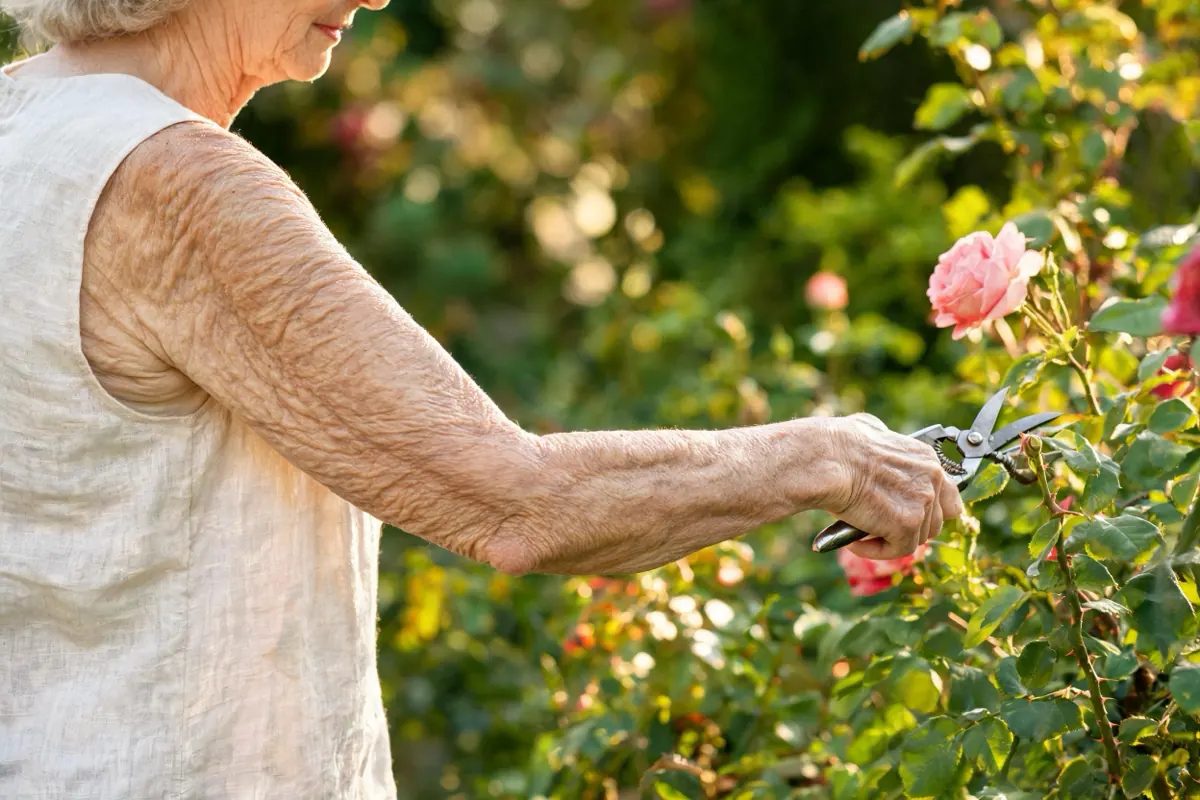
"Crepey" describes skin that looks thin, finely wrinkled and slightly loose — like crepe paper. On the arms, it often shows up on the upper arms and the inside of the elbows, and gets more noticeable when you lift your arm or after weight loss.
It's not just cosmetic for many people. In our anonymous quiz of U.S. adults over 55, 41% said they wear long sleeves even on warm days, and 31% said their main wish is to "wear short sleeves without thinking twice" [9].
What causes crepey skin on the arms?
- Sun damage. UV light breaks down collagen and elastic fibres and slows new collagen production [1]. Damaged elastic tissue (elastosis) gives skin a loose, weathered look [2].
- Natural aging. The skin thins and loses fat padding over the decades [2].
- Dryness. Older skin produces less oil, and dry skin shows every fine line.
- Weight loss. Losing weight, especially quickly, leaves skin with less to fill out.
- Genetics and smoking also play a part.
What actually helps
| Approach | Evidence | Realistic expectation |
|---|---|---|
| Topical retinoids (retinol, tretinoin) | Retinol on the arms of adults averaging 87 improved fine wrinkles and increased skin matrix over 24 weeks [3]; prescription retinoids are the best-studied [5] | Gradual improvement over 3–6 months; may irritate at first |
| Alpha-hydroxy acids (lactic, glycolic) | About 25% increase in skin thickness in a small pilot study [4] | Smoother texture over weeks; can sting thin skin |
| Moisturisers (ceramides, humectants) | Smoother look immediately; twice-daily moisturising reduced skin tears in aged care [8] | Instant plumping that lasts while you keep using it |
| Sun protection | Prevents further UV breakdown [6] | Stops it getting worse |
| In-office treatments (lasers, radiofrequency, microneedling, injectable biostimulators) | Varies by device | Can help; costly, needs a dermatologist |
What's mostly hype
- "Erases crepey skin in days" — no topical product rebuilds collagen that fast. Quick results come from moisturising and light-reflecting effects.
- Collagen creams — collagen molecules in creams are too large to rebuild your own collagen; they mainly moisturise.
- Firming wraps and body brushes — temporary tightening at most.
A routine that works
- Morning: moisturiser on arms, then broad-spectrum SPF 30+ if you'll be outside [6].
- Evening: a low-strength retinol or a lactic-acid lotion two or three nights a week, building up slowly; a ceramide moisturiser on other nights.
- Showers: short and lukewarm; moisturise within a few minutes of patting dry [7].
- Patience: judge after three months.
If your skin is very thin and bruises easily, go gently with retinoids and acids — see retinol for thin skin.
Crepey skin and bruising
Crepey skin and easy bruising often go together because both come from a thin, weakened dermis. If you see purple patches on crepey forearms, read about senile purpura and choose products that support the barrier as well as the look of the skin.
Frequently asked questions
What is the best treatment for crepey skin on arms?
Topical retinoids have the best evidence for rebuilding aged skin over months, with alpha-hydroxy acids as an alternative. Daily moisturising improves the look right away, and sun protection prevents further damage. Dermatologist treatments can add more.
Can crepey skin be reversed?
It can be improved, not fully reversed. Retinoids and AHAs have increased skin thickness and matrix in studies over several months. Consistent moisturising and sun protection help maintain results.
Does moisturiser help crepey skin?
Yes, for the look. Moisturisers plump the outer layer and make fine crepey lines less visible almost immediately. The effect lasts as long as you keep using them; for structural change, add a retinoid or AHA.
At what age does crepey skin start?
It often becomes noticeable in the 40s or 50s, earlier with a lot of sun exposure, and is very common after 60. Sun protection from any age slows it.
Is crepey skin the same as thin skin?
They overlap. Crepey describes the look — fine wrinkling and looseness — while thin skin describes reduced thickness that bruises and tears easily. Many people over 60 have both on their forearms.
Sources
- Rittié L, Fisher GJ Natural and sun-induced aging of human skin. Cold Spring Harbor Perspectives in Medicine, 2015. PubMed 25561721
- Aging changes in skin — MedlinePlus Medical Encyclopedia.
- Kafi R, et al. Improvement of naturally aged skin with vitamin A (retinol). Archives of Dermatology, 2007. PubMed 17515510
- Ditre CM, et al. Effects of alpha-hydroxy acids on photoaged skin: a pilot clinical, histologic, and ultrastructural study. Journal of the American Academy of Dermatology, 1996. PubMed 8642081
- Sadick N, et al. Topical Treatments for Photoaged Skin. Journal of Drugs in Dermatology, 2023. PubMed 37683070
- How to select a sunscreen — American Academy of Dermatology.
- Dermatologists' top tips for relieving dry skin — American Academy of Dermatology.
- Carville K, et al. The effectiveness of a twice-daily skin-moisturising regimen for reducing the incidence of skin tears. International Wound Journal, 2014. PubMed 25040325
- Fragile Skin Report 2027 — aggregated, anonymous answers from the Reunoa skin quiz — Reunoa Editorial (learn.reunoa.com).
General information, not medical advice. Written by the Reunoa editorial team; Reunoa makes Bruise Defense & Repair Serum. See our editorial policy for how we pick sources and keep product mentions fair.