Bruising on Xarelto (rivaroxaban): is it normal and what helps?
 By Margaret Hale, Reunoa EditorialLast updated
The short answer
Yes. Bruising more easily is an expected side effect of Xarelto (rivaroxaban), because it slows the clotting that seals tiny leaks under the skin. Small bruises on the arms and legs that fade over weeks are usually normal. Call your doctor for large unexplained bruises or other bleeding, and never stop Xarelto without talking to them first.
Key takeaways
- Rivaroxaban "may cause you to bruise or bleed more easily" — expected, not a sign it's harming you [1].
- In ROCKET AF, major bleeding was similar to warfarin, with less intracranial and fatal bleeding [3].
- Stopping Xarelto without advice raises stroke and clot risk [1].
- NSAIDs like ibuprofen and naproxen, aspirin and clopidogrel add to bleeding risk [1].
- Take Xarelto 15 mg and 20 mg doses with food, as directed [2].
On this page
Rivaroxaban, sold as Xarelto, is prescribed to prevent strokes in atrial fibrillation and to treat or prevent blood clots. If you've started it and your arms suddenly look like you've been in a fight, you're in good company — and in most cases, it's harmless.
Why Xarelto causes bruising
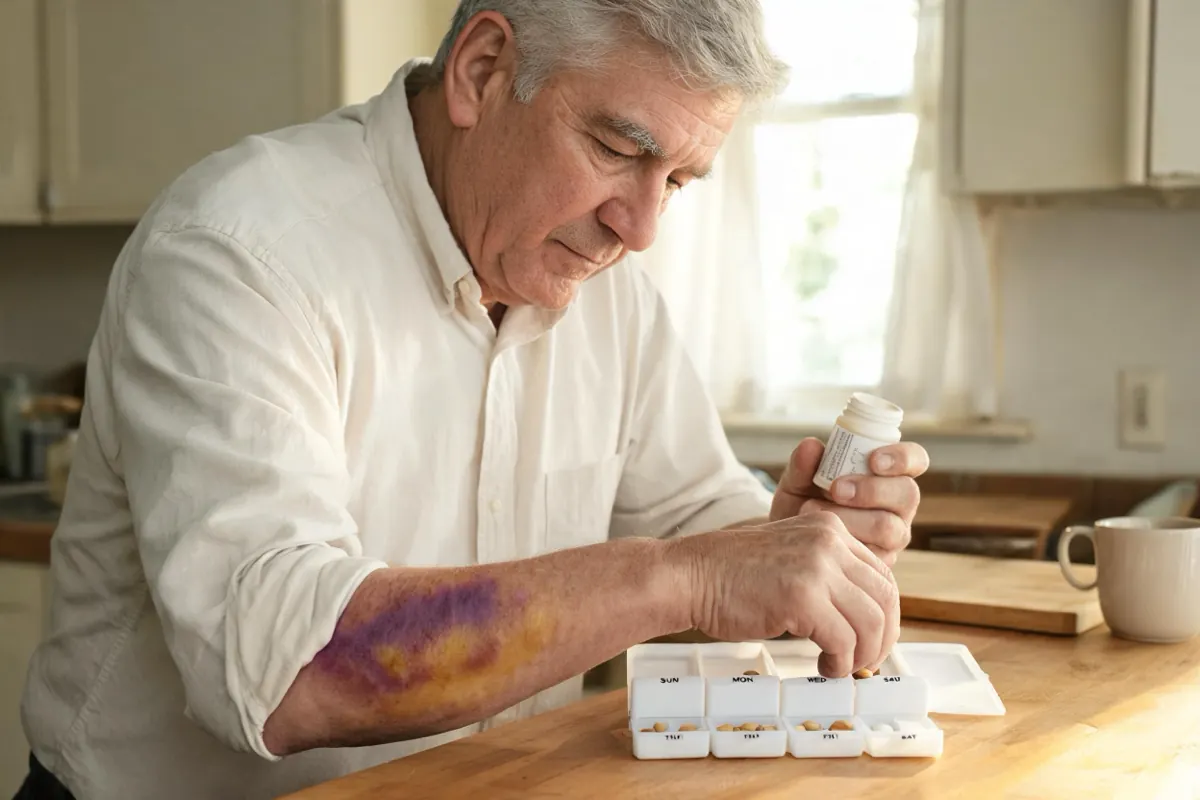
Rivaroxaban blocks factor Xa in the clotting cascade. Small capillary leaks that would normally seal within seconds keep oozing a little longer, so a bump leaves a visible bruise [1]. In older skin, which is thinner and has more fragile vessels [7], this shows most on the forearms, hands and shins.
What the big trial showed
The ROCKET AF trial compared rivaroxaban with warfarin in more than 14,000 people with atrial fibrillation. Rivaroxaban prevented strokes as well as warfarin; overall major bleeding was similar, while bleeding in the brain (0.5% vs 0.7%) and fatal bleeding (0.2% vs 0.5%) were lower with rivaroxaban [3]. A 2022 meta-analysis of all newer anticoagulants supports lower intracranial bleeding than warfarin overall [4].
Everyday bruising was not the main measure in these trials, but it is a well-known side effect of every anticoagulant.
Normal vs worrying
| Usually normal | Talk to your doctor |
|---|---|
| Bruises on arms, hands, legs after small knocks | Large bruises without any knock |
| Bruises fading over 2–3 weeks | Bruises that keep growing, or a swollen, tense, painful limb |
| Cuts bleeding a little longer | Nosebleeds or gum bleeding that won't stop |
| Purple patches on sun-damaged forearms | Pink/brown urine, black or bloody stools |
Don't stop Xarelto because of bruises
Stopping rivaroxaban without medical advice increases the risk of stroke [1]. Bruises are rarely a reason to stop. Instead:
- write down where and how big the bruises are
- bring the list and all your medicines and supplements to your next appointment
- ask whether your dose matches your kidney function and other medicines
What makes Xarelto bruising worse
- NSAID pain relievers (ibuprofen, naproxen) and aspirin unless prescribed [1]
- Other antiplatelets such as clopidogrel, when not specifically intended
- Supplements like high-dose fish oil, vitamin E, ginkgo or turmeric — tell your pharmacist
- Some antidepressants (SSRIs/SNRIs)
- Missing the food rule: 15 mg and 20 mg tablets are taken with food [2] — that's about absorption, not bruising, but taking it correctly keeps levels steady
Daily habits that help
- Moisturize forearms and hands morning and evening.
- Wear light long sleeves for jobs where your arms get knocked.
- Keep walkways clear and well lit to avoid bumps and falls.
- After a knock: cool pack wrapped in cloth for 10–15 minutes, then rest and raise the limb.
- Topical bruise products on unbroken skin act locally and don't alter rivaroxaban. A 20% arnica ointment helped bruises fade faster than placebo in a randomized trial [9].
Practical routine: how to stop bruising on blood thinners. Comparison with Eliquis: Eliquis bruising. In a 2021 study of more than 580,000 older adults with atrial fibrillation (observational, not randomized), hemorrhagic events were 7.5 vs 5.9 per 1,000 person-years with rivaroxaban vs apixaban [5].
Frequently asked questions
Is bruising a side effect of Xarelto?
Yes. Rivaroxaban can make you bruise or bleed more easily. Small bruises are expected; call your doctor if bruising is unusual, large or comes with other bleeding.
Does Xarelto cause more bruising than Eliquis?
There is no head-to-head trial focused on everyday bruising. Both cause easy bruising. In a large 2021 observational study of older Medicare patients, bleeding events were somewhat more frequent with rivaroxaban than apixaban, but your doctor chooses based on many factors — don't switch on your own.
How long do bruises last on Xarelto?
Usually two to three weeks, sometimes longer on thin forearm skin. A brown stain can linger after the purple fades.
Can I stop Xarelto for a few days to let bruises heal?
No. Stopping rivaroxaban, even briefly, can raise your risk of stroke or clots. Only stop if your doctor tells you to, for example before surgery.
What can I put on Xarelto bruises?
A cool pack in the first day, then gentle moisturizer. Topical arnica, vitamin K or ceramide products on unbroken skin act locally and don't change how Xarelto works.
Sources
- Rivaroxaban — Drug Information — MedlinePlus.
- Rivaroxaban — NHS.
- Patel MR, et al. Rivaroxaban versus warfarin in nonvalvular atrial fibrillation (ROCKET AF). New England Journal of Medicine, 2011. PubMed 21830957
- Carnicelli AP, et al. Direct Oral Anticoagulants Versus Warfarin in Patients With Atrial Fibrillation: Patient-Level Network Meta-Analyses of Randomized Clinical Trials. Circulation, 2022. PubMed 34985309
- Ray WA, et al. Association of Rivaroxaban vs Apixaban With Major Ischemic or Hemorrhagic Events in Patients With Atrial Fibrillation. JAMA, 2021. PubMed 34932078
- Bleeding into the skin — MedlinePlus Medical Encyclopedia (U.S. National Library of Medicine).
- Aging changes in skin — MedlinePlus Medical Encyclopedia.
- Blood Thinners — MedlinePlus (U.S. National Library of Medicine).
- Leu S, et al. Accelerated resolution of laser-induced bruising with topical 20% arnica: a rater-blinded randomized controlled trial. British Journal of Dermatology, 2010. PubMed 20412090
General information, not medical advice. Written by the Reunoa editorial team; Reunoa makes Bruise Defense & Repair Serum. See our editorial policy for how we pick sources and keep product mentions fair.