When should I worry about bruising? 10 red flags to know
 By Margaret Hale, Reunoa EditorialLast updated
The short answer
Worry about bruising — and see a doctor — if bruises appear without any knock in unusual places like the trunk, back or face; are larger than your palm; keep growing after two days; come with nosebleeds, bleeding gums, blood in urine or stools; or appear with fever, tiredness or weight loss. After a head injury on a blood thinner, seek emergency care.
Key takeaways
- Nearly 90% of accidental bruises in older adults are on the arms and legs [1].
- Bleeding into the skin other than a common bruise should be checked [2].
- Unexplained bruising can come from medicines, low platelets, liver disease or vitamin deficiencies [3].
- A head injury on any blood thinner needs urgent assessment [4].
- Doctors usually start with a blood count and clotting tests [3].
On this page
Most bruises after 60 are a nuisance, not a danger. But a few patterns deserve a doctor's attention. Here are the ten red flags, in order of urgency.
Call 911 or go to the ER
See a doctor within days
- Bruises without any knock in unusual places — trunk, back, face, inner arms. In older adults, accidental bruises are almost always on the arms and legs [1].
- Very large bruises (bigger than your palm) from minor or no injury.
- A bruise that keeps growing after two days, or becomes very swollen, tense and painful — possible hematoma.
- Bruising with other bleeding — nosebleeds, bleeding gums, heavy periods, blood in urine or stools [2].
- Bruising with tiredness, fever, night sweats, weight loss or frequent infections.
- Pinpoint red dots (petechiae) that don't fade when pressed [5].
- Sudden increase in bruising after starting a new medicine — or on warfarin, which may mean your INR is too high.
What's usually normal
- Bruises on forearms, hands and shins from minor bumps
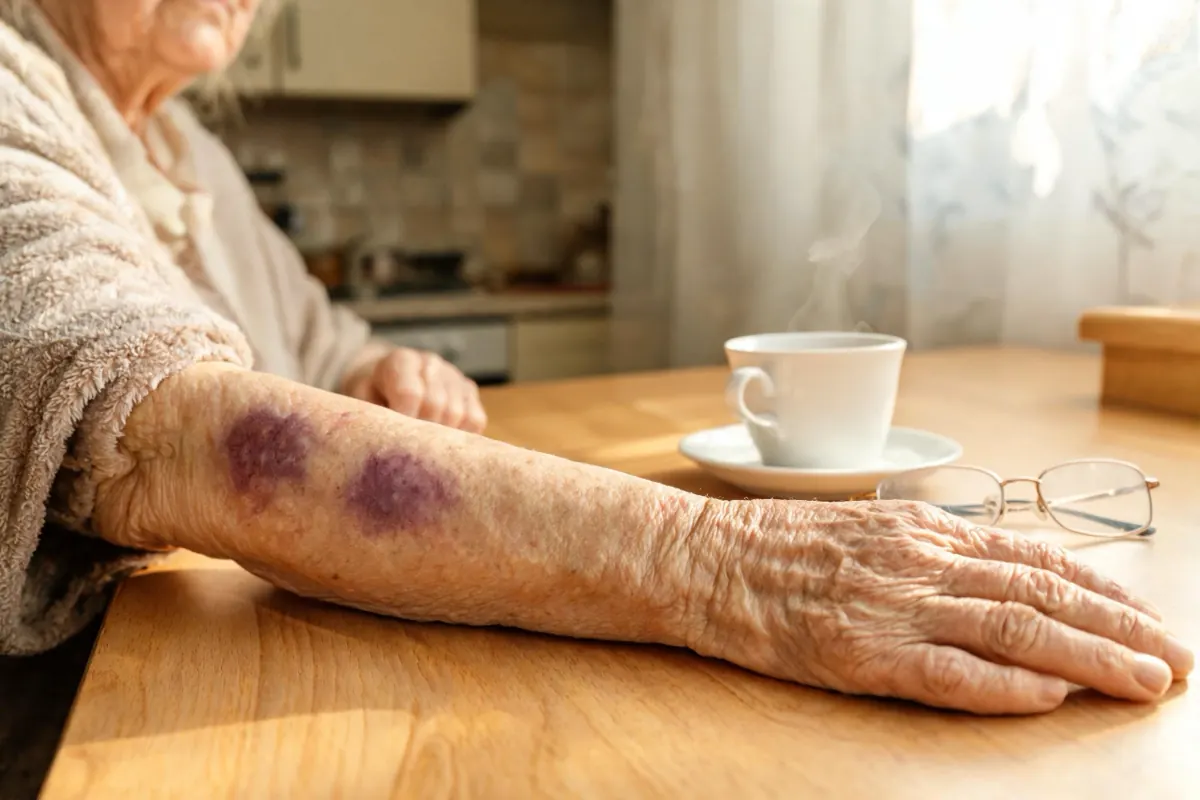
- Flat purple patches on sun-damaged forearms (senile purpura)
- More bruising on blood thinners or aspirin
- Bruises that take two to four weeks to fade, sometimes leaving a brown mark
- Not remembering the cause — common in older adults [1]
What the doctor will do
A doctor will ask about medicines (including supplements), falls, family history and other symptoms, then examine the bruises. Common first tests [3]:
- Complete blood count — including platelets
- Clotting tests (PT/INR, aPTT)
- Liver and kidney function
- Sometimes vitamin levels (C, K, B12, folate)
Causes they look for include medicines, low platelets [6], clotting disorders, liver disease, vitamin deficiencies and — rarely — blood cancers.
What usually happens next
For most people, tests come back normal and the bruising is explained by thin skin, sun damage and medicines. Your doctor may then suggest practical steps: a medicine review, protecting your skin, and keeping an eye on any change. If something is found — such as a low platelet count, a vitamin deficiency or a medicine interaction — it can usually be treated or adjusted. Either way, getting checked replaces worry with a plan.
For families: when bruises don't add up
Bruises on the face, outer right arm or back, very large bruises, or explanations that change can occasionally be signs of mistreatment; in research, abuse-related bruises were more often large and in those locations [7]. See unexplained bruising in an elderly parent.
Keep a bruise diary
Before your appointment, note for two weeks: date, location, size (coin for scale), possible cause and medicines. Photos help. This makes the visit far more useful.
Frequently asked questions
When is bruising a sign of something serious?
When bruises appear without injury in unusual places, are very large, keep growing, or come with other bleeding, fever, tiredness or weight loss.
What does a leukemia bruise look like?
There is no specific look. Concerning features are bruises without cause, petechiae and bruising with tiredness, infections, fever or bleeding gums. A blood count can rule it out.
Should I see a doctor for unexplained bruises?
If they're on your arms and legs and you're otherwise well, mention them at your next visit. See a doctor sooner if any red flag above applies.
What blood tests check for bruising?
Usually a complete blood count, clotting tests (PT/INR, aPTT), and sometimes liver function and vitamin levels.
Is it normal to not remember how I got a bruise?
Yes, especially after 60. In one study, older adults often didn't know the cause of bruises on their arms and legs.
Sources
- Mosqueda L, Burnight K, Liao S The life cycle of bruises in older adults. Journal of the American Geriatrics Society, 2005. PubMed 16078959
- Bleeding into the skin — MedlinePlus Medical Encyclopedia (U.S. National Library of Medicine).
- Ballas M, Kraut EH Bleeding and bruising: a diagnostic work-up. American Family Physician, 2008. PubMed 18481559
- Blood Thinners — MedlinePlus (U.S. National Library of Medicine).
- Purpura — MedlinePlus Medical Encyclopedia.
- Platelet disorders (thrombocytopenia) — MedlinePlus.
- Wiglesworth A, et al. Bruising as a marker of physical elder abuse. Journal of the American Geriatrics Society, 2009. PubMed 19558476
- Bruise — MedlinePlus Medical Encyclopedia.
General information, not medical advice. Written by the Reunoa editorial team; Reunoa makes Bruise Defense & Repair Serum. See our editorial policy for how we pick sources and keep product mentions fair.