Why do bruises take longer to heal as you age?
 By Margaret Hale, Reunoa EditorialLast updated
The short answer
Bruises take longer to heal with age because the body's repair process slows: inflammation, new blood vessel growth and the cleanup of leaked blood all take longer, skin blood flow decreases, and thin skin lets blood spread over a wider area. Blood thinners add more blood to clear. A bruise that fades in a week at 30 can take two to four weeks at 75.
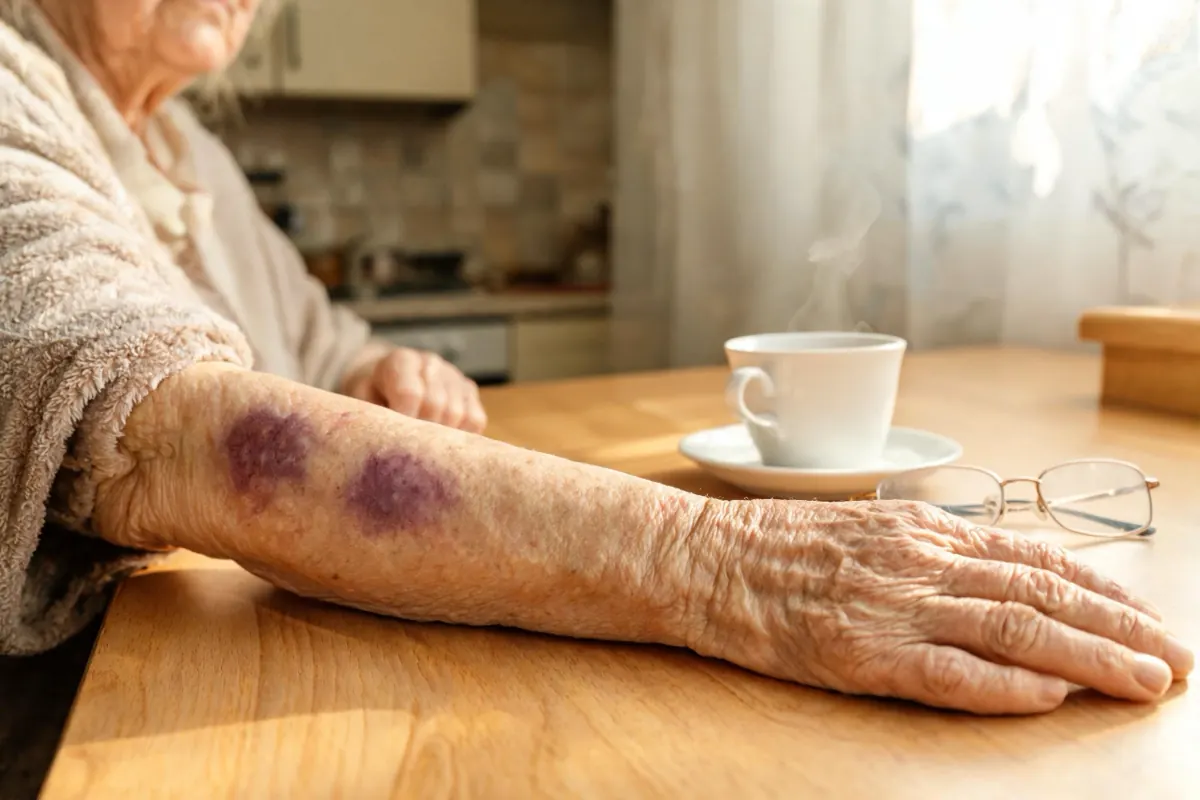
At 30, a bruise from the car door was gone in a week. At 75, the same bump leaves a mark for most of a month. Here's why.
1. Repair slows at every step
Healing follows the same stages at any age: an inflammatory phase, a building phase and a remodelling phase. A review of aging and wound healing describes delays in each: slower arrival of immune cells, slower formation of new blood vessels, slower collagen production and slower skin cell turnover [1]. A bruise is a small internal wound, and cleanup cells (macrophages) that break down leaked blood work more slowly.
2. Less blood flow in the skin
Studies measuring aged skin report changes in skin blood flow and structure [2]. Less circulation means cleanup takes longer.
3. Thin skin lets blood spread
Older skin is thinner with less supporting tissue [3]. Leaked blood spreads into a larger, flatter area — more to clear, more visible for longer.
4. More blood leaks in the first place
Blood thinners and aspirin keep small leaks open longer, so a bigger pool forms [7].
5. Iron gets left behind
When the body breaks down blood, iron is stored as hemosiderin. In older, sun-damaged skin it's often cleared slowly, leaving brown marks after senile purpura [4]. See hemosiderin staining.
Typical timelines
| Younger adult | Older adult | |
|---|---|---|
| Small bruise | About 1–2 weeks | Often 2–4 weeks |
| Senile purpura patch | — | 1–3 weeks, may leave brown [4] |
| On a blood thinner | Longer | Longer, larger |
These are rough guides. Colour isn't a precise clock — some bruises in older adults turned yellow within 24 hours [6], and research shows colour-based ageing of bruises is unreliable [5].
Where bruises heal slowest
Location matters. Bruises on the shins and feet usually take longest, because circulation is slower far from the heart and blood pools there when you stand. Forearms and hands are next, especially with thin, sun-damaged skin. Bruises on the face and trunk — where blood flow is good — usually clear fastest. If you have swollen ankles or varicose veins, lower-leg bruises can linger for many weeks and leave brown marks.
What can help bruises clear
- Cold pack early (wrapped, 10–15 minutes) in the first day after a knock
- Raise the limb to reduce pooling
- Gentle warmth after 48 hours may help circulation
- Topical ingredients: 20% arnica ointment sped fading versus placebo in a trial [8]
- Good nutrition: enough protein, fruit and vegetables for vitamin C
- Protect the area from repeat knocks
More: how to heal bruises fast.
Frequently asked questions
Is it normal for bruises to last a month in elderly people?
A bruise lasting three to four weeks can be normal in older skin, especially on blood thinners. Brown marks can last longer. See a doctor if it is growing, painful or not improving.
Why do old people's bruises turn brown?
Iron from broken-down blood is stored as hemosiderin. In older skin it's cleared slowly and can leave a brown stain.
Does vitamin C help bruises heal faster in older adults?
If you're low in vitamin C, correcting it supports collagen and healing. Extra vitamin C on top of normal levels hasn't been shown to speed bruise healing.
Do bruises heal slower on blood thinners?
Yes. More blood leaks into the skin, so the body has more to clear. That's expected and not a reason to stop the medicine.
Sources
- Gosain A, DiPietro LA Aging and wound healing. World Journal of Surgery, 2004. PubMed 14961191
- Waller JM, Maibach HI Age and skin structure and function, a quantitative approach (I): blood flow, pH, thickness, and ultrasound echogenicity. Skin Research and Technology, 2005. PubMed 16221138
- Aging changes in skin — MedlinePlus Medical Encyclopedia.
- Senile purpura — DermNet (New Zealand).
- Langlois NE The science behind the quest to determine the age of bruises — a review of the English language literature. Forensic Science, Medicine and Pathology, 2007. PubMed 25869263
- Mosqueda L, Burnight K, Liao S The life cycle of bruises in older adults. Journal of the American Geriatrics Society, 2005. PubMed 16078959
- Blood Thinners — MedlinePlus (U.S. National Library of Medicine).
- Leu S, et al. Accelerated resolution of laser-induced bruising with topical 20% arnica: a rater-blinded randomized controlled trial. British Journal of Dermatology, 2010. PubMed 20412090
General information, not medical advice. Written by the Reunoa editorial team; Reunoa makes Bruise Defense & Repair Serum. See our editorial policy for how we pick sources and keep product mentions fair.