Why do older people bruise so easily?
 By Margaret Hale, Reunoa EditorialLast updated
The short answer
Older people bruise easily because skin gets thinner and loses its fat cushion, collagen that supports small blood vessels breaks down with age and sun, vessels tear from smaller knocks, healing slows, and many older adults take blood thinners, aspirin or steroids. Most bruises are on the arms and legs and are harmless.
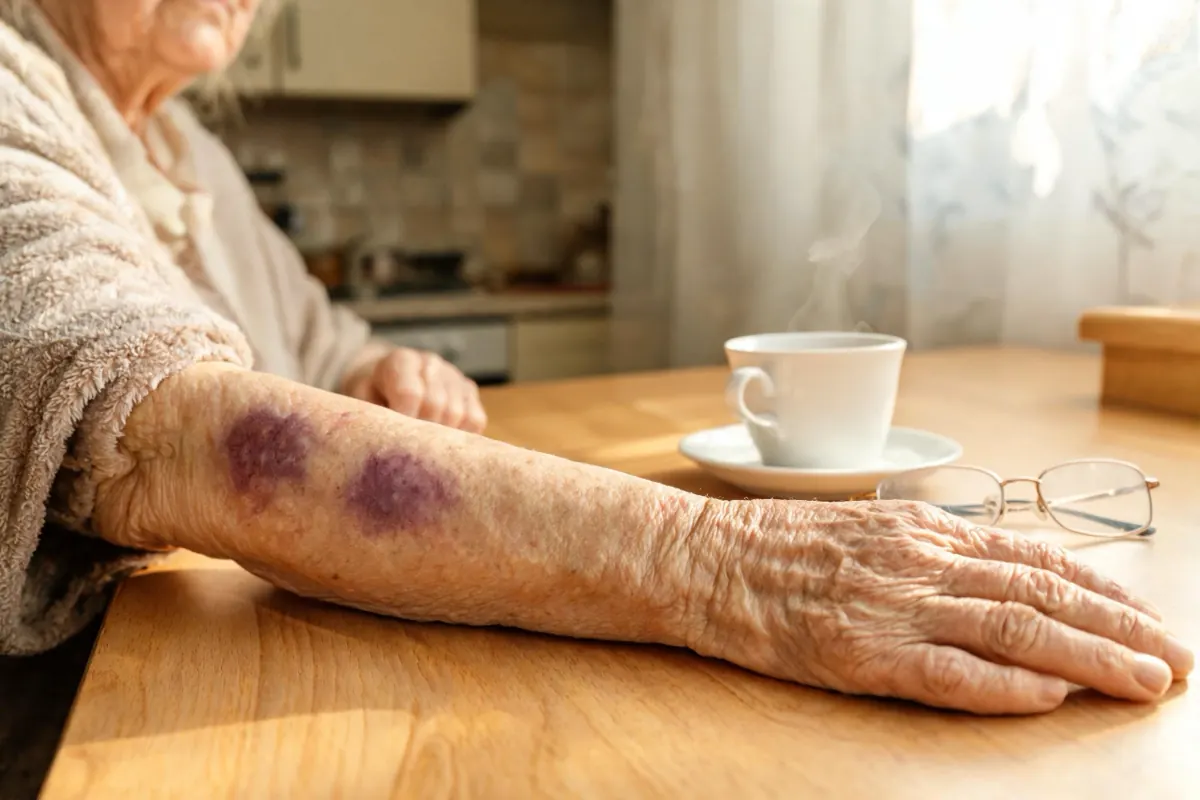
If you're over 65 — or watching a parent age — you've probably seen bruises appear from almost nothing. It's one of the most visible changes in aging skin, and it has five clear causes.
1. Thinner skin
With age, the outer and middle layers of skin get thinner and the skin loses fat padding underneath [1]. Quantitative studies of skin structure confirm these changes with age [3]. Less tissue means less protection for the small vessels underneath.
2. Weaker support around blood vessels
Collagen and elastic fibres act like scaffolding around capillaries. Both decline with natural aging, and decades of sun speed this up dramatically [2]. Without that scaffolding, vessels tear from forces that wouldn't bother younger skin. On sun-exposed forearms this leads to senile purpura — flat purple patches that affect more than 10% of people over 50 [8].
3. Slower healing
Every step of repair — inflammation, new vessel growth, collagen building, skin cell turnover — slows with age [4]. Bruises take longer to clear, so they're visible longer and more of them overlap. More: why bruises take longer to heal as you age.
4. Medicines
Older adults are far more likely to take medicines that increase bruising:
- Blood thinners (Eliquis, Xarelto, warfarin) and antiplatelets (aspirin, Plavix) [6]
- Steroids — tablets, inhalers and strong creams thin the skin [7]
- NSAIDs like ibuprofen, some antidepressants, and supplements such as fish oil or vitamin E
5. More bumps, fewer noticed
Poorer eyesight, balance and reaction time mean more knocks — and many go unnoticed. In a study tracking bruises in older adults, nearly 90% were on the arms and legs, and people often didn't know what caused them [5].
How the five reasons add up
None of these changes alone would cause many bruises. Together, they multiply: thinner skin means a knock reaches the vessels; weaker support means the vessel tears; a blood thinner means more blood escapes; slower healing means the bruise stays visible for weeks; and more knocks mean new bruises appear before old ones fade. That's why someone can go from "never bruised" at 55 to "always bruised" at 75.
The good news is that several of these factors can be influenced. Sun protection slows further collagen loss, moisturizing keeps skin more supple, a safer home means fewer knocks, and a medication review can remove unnecessary extra blood-thinning effects.
Is it normal?
Yes, for bruises on the forearms, hands and shins from minor knocks. Bruises in unusual places, very large ones or bruising with other bleeding should be checked. See when should I worry about bruising?
What helps
- Moisturize arms and legs twice a day
- Wear light long sleeves for chores
- Use sunscreen on forearms and hands
- Pad sharp corners and improve lighting
- Review medicines and supplements yearly with a doctor or pharmacist
- Never stop a blood thinner because of bruises
Frequently asked questions
At what age do people start bruising easily?
Many notice it from their 50s or 60s, earlier with lots of sun exposure or steroid use. It typically increases with each decade.
Why do elderly people get big purple bruises?
Thin, sun-damaged skin lets blood spread further, and blood thinners make leaks larger. Flat purple patches on forearms are usually senile purpura.
Can older people stop bruising easily?
Not completely, but moisturizing, sun protection, sleeves, a safer home and a medication review can reduce bruises noticeably.
Is easy bruising in the elderly a sign of something serious?
Usually not. It's worth checking if bruises are in unusual places, very large, unexplained, or come with other bleeding or feeling unwell.
Sources
- Aging changes in skin — MedlinePlus Medical Encyclopedia.
- Rittié L, Fisher GJ Natural and sun-induced aging of human skin. Cold Spring Harbor Perspectives in Medicine, 2015. PubMed 25561721
- Waller JM, Maibach HI Age and skin structure and function, a quantitative approach (I): blood flow, pH, thickness, and ultrasound echogenicity. Skin Research and Technology, 2005. PubMed 16221138
- Gosain A, DiPietro LA Aging and wound healing. World Journal of Surgery, 2004. PubMed 14961191
- Mosqueda L, Burnight K, Liao S The life cycle of bruises in older adults. Journal of the American Geriatrics Society, 2005. PubMed 16078959
- Blood Thinners — MedlinePlus (U.S. National Library of Medicine).
- Prednisone — Drug Information — MedlinePlus.
- Senile purpura — DermNet (New Zealand).
General information, not medical advice. Written by the Reunoa editorial team; Reunoa makes Bruise Defense & Repair Serum. See our editorial policy for how we pick sources and keep product mentions fair.