How long does senile purpura last?
 By Margaret Hale, Reunoa EditorialLast updated
The short answer
Each senile purpura patch usually fades within one to three weeks. The brown stain it can leave behind may last weeks to months, sometimes longer. The tendency itself is long-term: as long as the skin stays thin and fragile, new patches tend to appear after minor knocks — though sun protection, moisturizing and protecting the arms can reduce them.
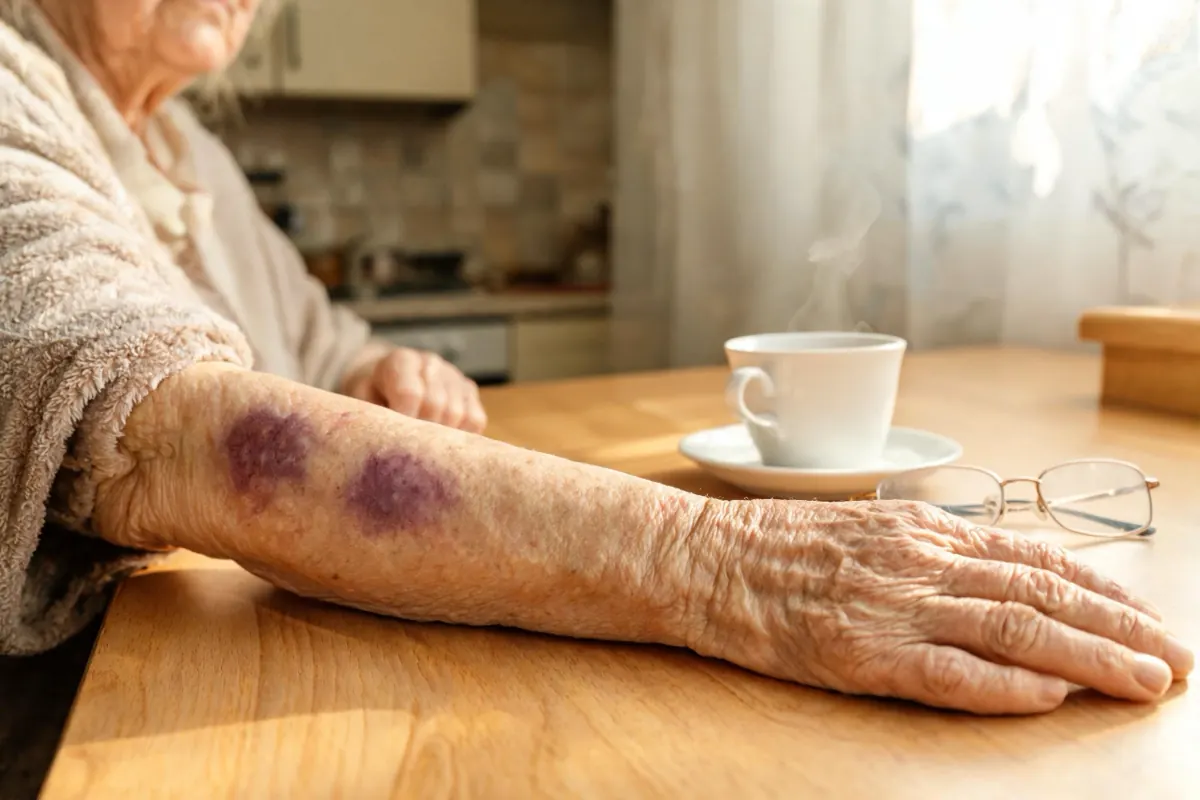
There are two questions hidden in "how long does it last": how long one patch lasts, and how long the condition lasts. The answers are very different.
One patch: one to three weeks
DermNet describes senile purpura patches as resolving over one to three weeks [1]. A typical patch:
| Days | What happens |
|---|---|
| 0–2 | Appears, deep red-purple, flat, sharp edges |
| 3–10 | Stays dark purple; no green or yellow phase |
| 10–21 | Fades, turns duller and brownish |
| Weeks–months | A brown stain may remain |
The brown stain: weeks to months
When patches fade, iron from the blood (hemosiderin) can stay in the skin and leave residual brown pigmentation [1]. Over years, repeated patches in the same area can leave a lasting bronze tint. See does hemosiderin staining go away?
The condition: often for years
The underlying cause — thin, sun-damaged skin with fragile vessels — doesn't disappear. DermNet notes that, unfortunately, new lesions tend to keep appearing [1]. Many people find it comes in waves: more in summer (sleeves off, more knocks), after starting a blood thinner or steroid, or after an illness.
Can you make patches fade faster?
There is no proven way to make an existing patch disappear overnight. What the evidence suggests:
- High-strength arnica: 20% arnica ointment helped bruises fade faster than placebo in a randomized trial [3].
- Vitamin K: reduced bruise severity after laser treatment in a controlled study [4].
Those studies used laser-induced bruises, not senile purpura, so results may differ.
Can you get fewer new patches?
Yes, several approaches help:
- Citrus bioflavonoids: in a randomized, double-blind, placebo-controlled study, a citrus bioflavonoid supplement reduced new purpura lesions by 50% after six weeks [2].
- Moisturize twice daily — supple skin copes better with friction [5].
- Sun protection — to slow further skin thinning [1].
- Sleeves and padding — fewer knocks.
More: senile purpura treatment.
Why some patches last longer
- Blood thinners and steroids: more blood leaks, so there is more to clear.
- Larger patches: a 4 cm patch takes longer than a 1 cm one.
- Repeated knocks in the same spot: new leaks on top of old ones.
- Very thin, sun-damaged skin: slower clearing and more brown staining.
Keeping a simple photo diary — same arm, same light, once a week — shows you the real pattern and is useful to share with your doctor.
Frequently asked questions
How long do senile purpura spots last?
Each spot usually fades within one to three weeks. A brown mark may remain for weeks to months.
Does senile purpura ever go away completely?
Individual patches do. The tendency to get new ones usually continues, because it's caused by long-term skin thinning and sun damage.
Why are my purple spots not fading?
If a patch hasn't faded after three to four weeks, or keeps growing, have a doctor look at it. Brown stains that remain after purple fades are common and harmless.
Can senile purpura be reversed?
The sun damage can't be fully reversed, but skin can be strengthened and new patches reduced. See our guide on whether senile purpura can be reversed.
Sources
- Senile purpura — DermNet (New Zealand).
- Berlin JM, et al. A randomized, placebo-controlled, double-blind study to evaluate the efficacy of a citrus bioflavanoid blend in the treatment of senile purpura. Journal of Drugs in Dermatology, 2011. PubMed 21720653
- Leu S, et al. Accelerated resolution of laser-induced bruising with topical 20% arnica: a rater-blinded randomized controlled trial. British Journal of Dermatology, 2010. PubMed 20412090
- Shah NS, et al. The effects of topical vitamin K on bruising after laser treatment. Journal of the American Academy of Dermatology, 2002. PubMed 12140470
- Carville K, et al. The effectiveness of a twice-daily skin-moisturising regimen for reducing the incidence of skin tears. International Wound Journal, 2014. PubMed 25040325
General information, not medical advice. Written by the Reunoa editorial team; Reunoa makes Bruise Defense & Repair Serum. See our editorial policy for how we pick sources and keep product mentions fair.